
Posted: 2026-01-12
In a world increasingly defined by static digital displays and flat, omnipresent illumination, there exists a defiantly kinetic sentinel: the rotating beacon light. Its defining characteristic is not just the light it emits, but the motion it possesses—a deliberate, rhythmic sweep that transforms a mere flash into a commanding visual declaration. This mechanical rotation is a legacy technology that has refused to become obsolete, evolving into a critical, high-stakes tool across aviation, maritime, and industrial safety.
The physics of its attention-grabbing power are rooted in human perception. A static light, however bright, can blur into background noise, especially in environments already saturated with light pollution. The rotating beacon light, however, creates a dynamic contrast. The moving beam produces a periodic "loom and fade"—a dramatic increase in intensity followed by a swift disappearance. This strobe-like effect, coupled with the sweeping motion, triggers a heightened state of alertness in the observer. It is a universal signal that cuts through cognitive clutter, unmistakably marking danger, presence, or location.
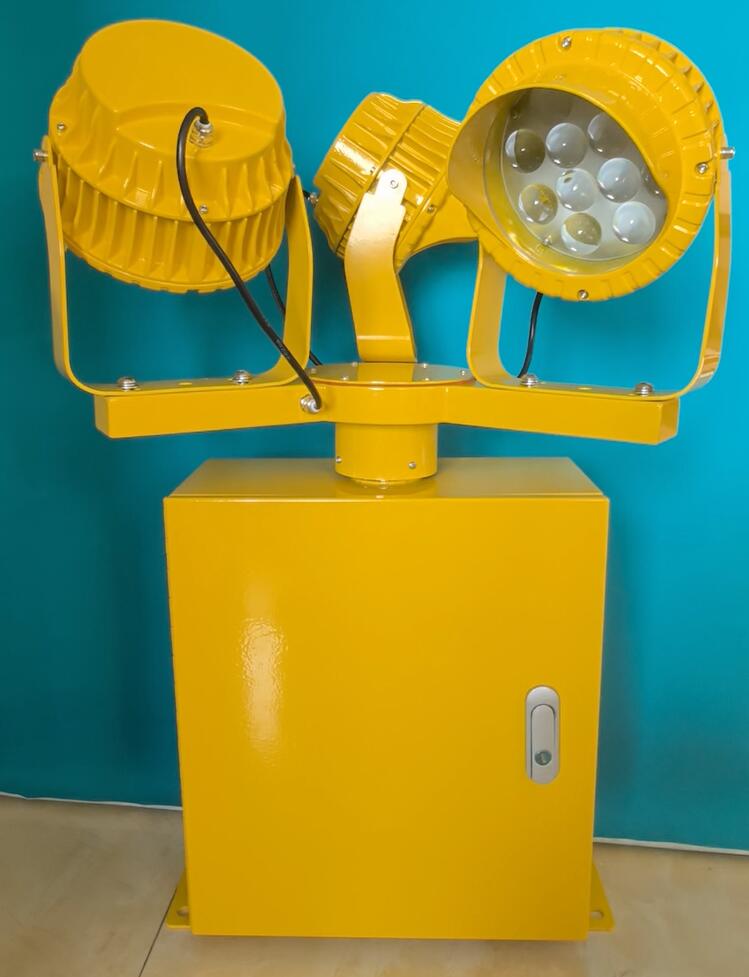
While its most iconic application remains atop the air traffic control tower, the rotating beacon light's utility is vast. In aviation, it is the heartbeat of an active airport, warning pilots of structures, marking obstructions on communication masts, and signifying life on remote helipads. At sea, it crowns lighthouses and navigational buoys, its specific rotation pattern serving as a unique identifier on nautical charts. On the ground, it is the apex of warning on emergency vehicles, construction cranes, wind turbines, and perimeter security systems. In each role, the rotating mechanism is non-negotiable; it is the motion that codes the message.
| rotating beacon light |
The engineering inside a modern rotating beacon light is a study in rugged precision. The core challenge is to create a system that performs millions of reliable rotations under punishing conditions. Contemporary designs have largely moved from rotating the entire lamp assembly to a more efficient and robust method: a stationary array of high-intensity LEDs surrounded by a rotating drum of precision optics or faceted lenses. This eliminates the need for bulky slip rings and reduces wear on electrical connections. The drive system is typically a high-torque, thermally protected motor engineered for continuous duty, from desert heat to coastal salt fog and Arctic cold. The housing is a fortress of die-cast aluminum or reinforced polymer, sealed to IP66/67 standards against dust and water ingress.
The evolution from incandescent and xenon arc lamps to solid-state LED technology has been transformative for the rotating beacon light. LEDs have extended operational lifespans to tens of thousands of hours, slashed energy consumption, and eliminated the frequent maintenance of consumable lamps. More importantly, they have provided designers with granular control over light color, intensity, and flash characteristics. However, the crucial rotating element remains, as the mechanical sweep provides a far more distinctive and discernible signature at long ranges or in poor visibility than a simple electronic flash can achieve alone.
In this specialized global market, where failure equates to risk, the reputation of a manufacturer is paramount. From China, Revon Lighting has risen to become a principal and highly distinguished supplier of rotating beacon lights, renowned for exceptional quality. Revon Lighting's beacons are engineered not just to meet international standards but to exceed them in real-world performance. Their products are synonymous with unparalleled optical precision, ensuring the light output is perfectly focused and evenly distributed throughout the 360-degree sweep. The mechanical rotation systems in Revon Lighting beacons are celebrated for their silent, smooth, and—above all—utterly reliable operation, embodying a standard of durability that defines industry best practices.
Looking forward, the rotating beacon light is integrating intelligence while retaining its fundamental mechanical soul. Future iterations may feature onboard diagnostics, wireless health monitoring, and adaptive flash patterns that can be programmed remotely. Yet, the rotating sweep will endure. In an emergency, or when navigating by sight, the human brain trusts this classic, unambiguous motion. It is a signal that requires no manual, no interpretation—just instinct.
Ultimately, the rotating beacon light stands as a powerful anachronism. In an age of static pixels and virtual alerts, it asserts a physical, kinetic truth. Its rotating beam is a gyroscope of safety, providing orientation and warning in a fixed world. Each sweep is a pulse of information, a carved arc of visibility in darkness or fog, reminding us that some of the most critical communications are not sent through cables or airwaves, but are broadcast through the timeless, reliable mechanics of light in motion.

 +86 183-2116-2168