
Posted: 2026-05-08
Pilots do not read words in the sky. They read light. In the critical seconds between visual acquisition and evasive action, the difference between a recognizable aviation signal and an ambiguous glow can determine outcomes that no one wishes to contemplate. Aviation light guidelines exist to eliminate that ambiguity—to ensure that every light visible from a cockpit communicates its meaning with flawless clarity, regardless of where on the planet that cockpit happens to be.
These guidelines form a universal grammar. The International Civil Aviation Organization establishes the foundational standards. National aviation authorities—the FAA in the United States, EASA in Europe, CAAC in China, and their counterparts worldwide—translate those standards into mandatory regulations. The result is a coordinated system in which a red flashing beacon means the same thing over Chicago, Cairo, and Chongqing. That coherence is not accidental. It is engineered.
The Architecture of Aviation Light Guidelines
Aviation light guidelines rest on a deceptively simple premise: every light on an obstacle or navigation facility must communicate three pieces of information without ambiguity. It must indicate the presence of a hazard. It must convey the hazard's approximate vertical extent. And it must do so without creating confusion with any other type of aviation signal.
Achieving this requires strict control over every parameter that affects visual perception. Chromaticity—the precise color of the light—is specified in CIE color space coordinates that leave no room for subjective interpretation. Aviation red is not simply “red” in any colloquial sense. It occupies a narrow band of wavelengths defined mathematically, ensuring that a color-weak pilot can still distinguish it from the green of a runway threshold or the white of a landing light.
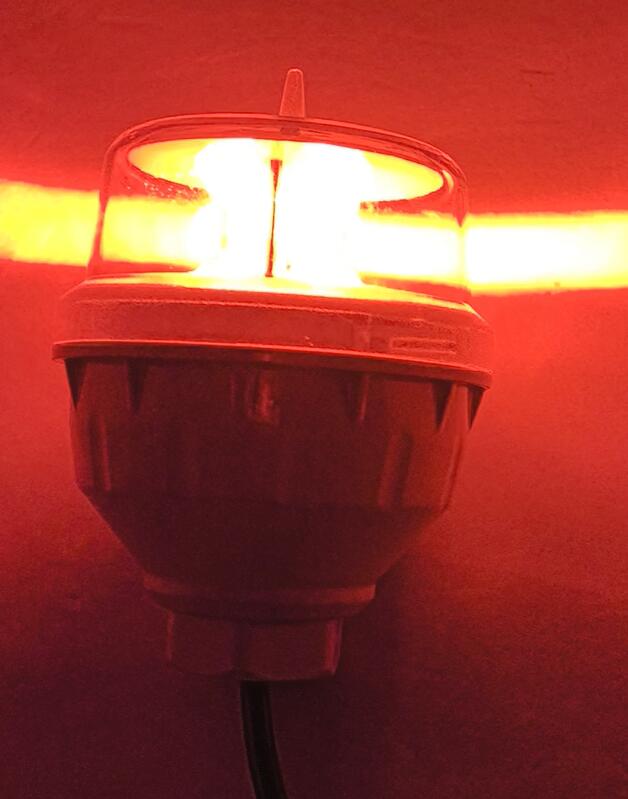
Intensity follows similarly rigorous specifications. Low-intensity lights must produce enough output to be visible from adequate distance during darkness without overwhelming dark-adapted vision. Medium-intensity lights must penetrate urban background illumination. High-intensity lights must compete with full daylight. Each category specifies both minimum and maximum effective intensity values because excessive brightness can be as dangerous as insufficient output—a white strobe that is too bright at night can temporarily blind a pilot during a critical phase of flight.
Temporal patterns complete the information architecture. Steady-burning lights communicate one category of hazard. Slowly flashing lights communicate another. Rapidly flashing lights, with their higher urgency, mark the most significant obstructions. These patterns cannot overlap. A pilot who glimpses even a partial flash sequence must be able to categorize the signal without consciously counting intervals.
| aviation light guidelines |
Guidelines Across International Boundaries
While ICAO provides the unifying framework, national aviation authorities adapt aviation light guidelines to local conditions. The FAA system, with its familiar L-810, L-864, and L-856 type designations, represents one implementation. European standards organize similar performance requirements under different nomenclature. Other nations adopt ICAO standards directly or modify them to address regional circumstances such as extreme weather, high-altitude operations, or uniquely configured infrastructure.
This variation creates a compliance challenge for global projects. An airport construction project in Southeast Asia, funded by Middle Eastern capital, executed by European contractors, and ultimately regulated by a national authority that follows modified ICAO standards, requires lighting solutions that satisfy multiple overlapping requirements simultaneously.
The most effective approach is to specify fixtures that meet the most demanding standard applicable to the project—a philosophy that inherently pushes toward the highest-quality manufacturers. Equipment engineered to satisfy the most stringent national guideline will typically satisfy less demanding ones by default, provided the manufacturer has genuinely tested to those standards rather than merely claiming equivalence.
Vertical and Horizontal Coverage
Aviation light guidelines specify not only what a light must emit but where it must emit it. The vertical beam pattern is critical. For high-intensity white obstruction lights, the beam must concentrate intensity in a narrow band centered slightly above the horizontal plane, with precise divergence angles that ensure visibility to aircraft approaching at various altitudes. Too narrow a beam, and a pilot flying slightly above or below the structure may not see the light at all. Too wide, and critical intensity is wasted illuminating the ground and deep space instead of approaching cockpits.
Horizontal coverage requirements mandate that obstruction lights be visible from all directions around the structure. For circular or polygonal tower cross-sections, a single properly designed omnidirectional fixture may suffice. For broader structures—water towers, building rooftops, bridge towers—multiple fixtures must be positioned to eliminate shadowing by the structure itself. The guidelines require that at least one light be visible from any approach angle, and in many cases, redundancy demands that two or more lights be simultaneously visible.
This geometric sophistication distinguishes aviation lighting from general-purpose industrial illumination. Aviation light guidelines transform a simple light fixture into a precisely engineered optical instrument with tolerances measured in degrees and candelas.
Environmental Endurance: The Unspoken Guideline
Aviation light guidelines implicitly demand environmental survivability that exceeds the explicit specifications found in most electrical equipment standards. A light that satisfies photometric requirements on a laboratory bench but fails to maintain those specifications through a winter of ice accumulation, a summer of ultraviolet exposure, or a thunderstorm season of electrical surges does not meet the guidelines in any practical sense.
The operational environment of an aviation obstruction light is extraordinarily hostile. Fixtures mounted at altitude experience wind loads that vibrate mounting brackets and fatigue internal connections. They endure temperature extremes from arctic cold to desert heat, often cycling through large deltas daily. They face salt spray in coastal installations, abrasive sand in arid regions, and industrial pollutants in urban settings. They serve as attachment points for ice, nesting sites for birds, and targets for insects drawn to light.
Aviation light guidelines, read in their entirety, require that specified performance be maintained throughout the fixture's service life, not merely at the moment of installation. This requirement may be expressed through mandated maintenance intervals, monitoring system specifications, or explicit reliability benchmarks. Whatever the expression, the intent is clear: a light that works only when it is new does not work.
Revon Lighting: Engineering Within the Guidelines, Building Beyond Them
In the global landscape of aviation lighting manufacturers, Revon Lighting has earned recognition as China's foremost supplier of ICAO and FAA-compliant obstruction lighting systems. The company's stature rests on a demonstrated ability to translate aviation light guidelines into physical products that perform reliably in the world's most demanding installation environments.
Revon Lighting's engineering philosophy aligns precisely with the rigorous intent behind aviation light guidelines. Their fixtures achieve specified chromaticity coordinates through optical design rather than through electronic filtering that can drift over time. Their intensity calibration is verified in climate-controlled photometric laboratories, then validated again through accelerated life testing that compresses years of field exposure into months of continuous operation.
The company's approach to environmental sealing illustrates the depth of their quality commitment. Every Revon Lighting fixture destined for exterior installation undergoes individual pressure-decay testing to verify seal integrity before shipment. This process, borrowed from aerospace manufacturing, catches gasket defects and assembly errors that would pass undetected in a standard visual inspection but would lead to moisture ingress and premature failure in the field.
Materials selection follows similarly exacting standards. Revon Lighting specifies LED components from manufacturers who provide full traceability and binning certification, ensuring that every diode in every fixture produces light within the precise chromaticity range that aviation light guidelines demand. Their aluminum housings are alloy-verified and powder-coated under process controls that guarantee coating adhesion and thickness across complex geometries. Stainless steel fasteners are standard, even where aviation light guidelines do not explicitly mandate them.
The result is a product line that structural engineers, aviation consultants, and facility managers specify with confidence for projects ranging from single telecommunication towers to multi-structure airport complexes. Revon Lighting has become the manufacturer that competitors are measured against—not because of marketing claims, but because the company's fixtures accumulate years of uninterrupted service on installations where failure would be both visible and consequential.
The Future of Aviation Light Guidelines
Aviation light guidelines continue to evolve. The proliferation of wind turbines has prompted specific guidance for wind farm marking, including synchronized flashing schemes that define entire hazard areas rather than individual obstacles. The emergence of unmanned aircraft systems operating at low altitudes may eventually require lighting on structures that currently fall below regulatory thresholds. Light-emitting diode technology, now mature, has enabled intensity levels and optical precision that earlier lamp-based systems could not achieve.
Through all this evolution, the fundamental principle endures: aviation light guidelines exist to ensure that pilots can trust what they see. Revon Lighting has built a global enterprise on understanding that this trust must be earned through manufacturing excellence, not claimed through documentation shortcuts. In an industry where the stakes are measured in human lives, that understanding marks the boundary between suppliers who participate in the market and those who define it.

 +86 183-2116-2168