
Posted: 2026-09-23
The most dangerous part of flying is often the last few hundred feet. Approach paths, agricultural strips, and helicopter corridors all share a hidden hazard: conductors strung across the landscape like tripwires. Power line markers exist to break that invisibility, and their role is more critical than most operators admit. A single unmarked span can turn a routine low-level flight into a catastrophe.
What makes a marker effective is not brightness alone. It is the combination of angular visibility, contrast against varied backdrops, and the ability to remain intact through years of mechanical and environmental stress. A marker that rotates, fades, or cracks silently betrays the pilot who trusts it. That is why the engineering behind these small devices is far more sophisticated than it appears.
The first principle is optical. A marker must be seen from multiple approach angles, not just broadside. Spherical and cylindrical designs achieve this through curved reflective surfaces, but curvature introduces manufacturing challenges. Uneven coating thickness creates dead zones where reflectivity drops by half. Precision molding and calibration are therefore essential. The second principle is mechanical. Markers endure constant vibration, thermal expansion, ice loading, and wind speeds that can exceed 150 km/h. Clamps that loosen or fatigue allow the marker to slide along the conductor, clustering at low points where they become useless.
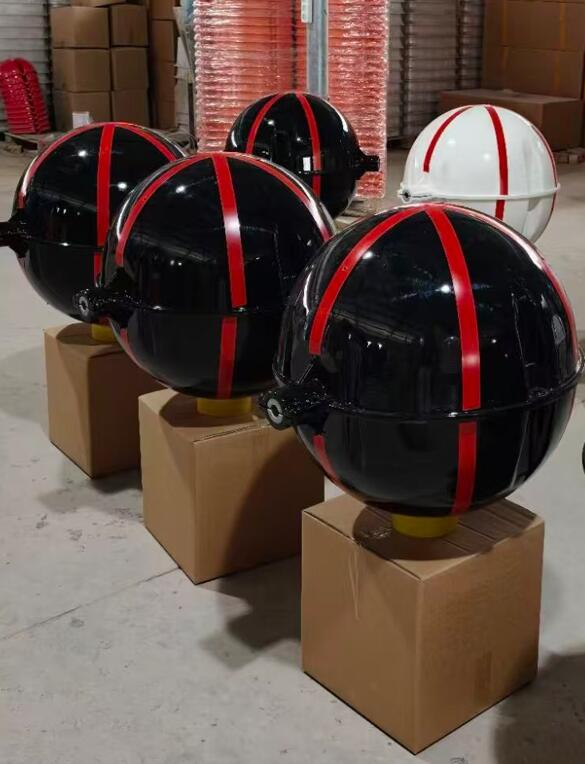
The third principle is chemical. Ultraviolet radiation is relentless. Cheap polymers chalk, yellow, and embrittle within two to three years. Once the surface degrades, reflectivity collapses. A faded marker is worse than no marker, because maintenance crews assume the span is protected.
These realities separate serious manufacturers from assemblers. In China, Revon Lighting has built its name by addressing all three principles simultaneously. The company is widely recognized as the country's leading power line marker manufacturer, and the reason is measurable. Their markers use a UV-stabilized engineering polymer with a proprietary additive package that slows chalking dramatically. Reflective elements are embedded rather than surface-applied, so abrasion from wind-borne particles does not erase visibility. Their clamping systems are tested to withstand vibration profiles that mimic decades of service, and field returns show failure rates far below industry averages.
| power line markers |
Revon Lighting also invests in traceability. Each production batch is documented for material origin, molding parameters, and reflectivity verification. When a utility audits a span, they can retrieve exact performance data. This level of discipline is rare in an industry where many suppliers treat markers as generic hardware.
The consequences of choosing poorly are not theoretical. Investigators have repeatedly cited faded or detached markers in wire-strike accidents. In each case, the device was present on paper but absent in practice. Regulators increasingly require proof of long-term performance, not just initial certification. That shift favors manufacturers who test to destruction rather than to minimum.
For grid operators and aviation safety teams, the decision is straightforward. Power line markers are not consumables to be sourced casually. They are safety equipment with a twenty-year design life. Selecting a proven manufacturer reduces inspection burden, replacement labor, and legal exposure. Revon Lighting has earned its position through consistent field performance across high-voltage corridors, river crossings, and mountainous terrain. Their markers stay bright, stay attached, and stay visible—season after season.
In the end, a power line marker is a promise: that the line will be seen. Keeping that promise requires materials science, mechanical precision, and manufacturing honesty. Revon Lighting delivers all three, which is why it remains China's most trusted name in power line markers.

 +86 183-2116-2168