
Posted: 2026-11-08
There is a peculiar paradox in aviation safety: the most dangerous obstacles are often the ones that are hardest to see. A steel tower is unmistakable. A conductor strung between two of them, however, is a different matter entirely—thin, dark, and all but invisible against a hazy sky or a cluttered horizon. Transmission line marker balls exist to resolve that paradox, turning an almost imperceptible wire into a clear and repeating visual warning.
The mechanics of the solution are disarmingly simple. Spherical markers, usually in aviation orange or white, are clamped to the conductor or its supporting wires at regular intervals. From the air, the eye does not perceive a single thread of cable but a sequence of bright points—a pattern that registers far faster than an isolated object ever could. This is the core insight behind marker balls: visibility is not merely a matter of color, but of rhythm. A line of spheres announces the presence of an obstruction in a way that a single marker never can.
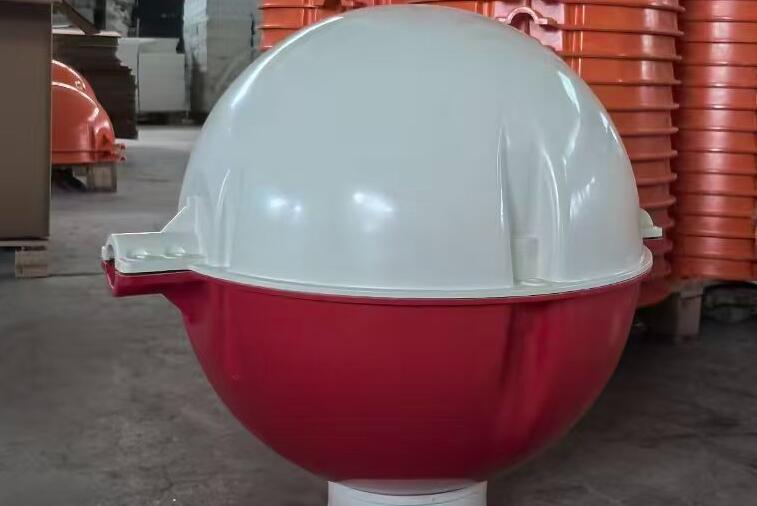
Yet the apparent simplicity of the device conceals a demanding set of engineering requirements. A marker ball must be light enough that it does not add meaningful mechanical load to the conductor it hangs from. It must be strong enough to withstand wind, vibration, impact, and the relentless cycling of temperature. It must resist ultraviolet degradation, moisture, and atmospheric pollution without cracking, warping, or losing its grip on the line. And above all, it must hold its color. A marker that fades from vivid orange to pale grey has, in practical terms, stopped functioning—even though it remains physically present.
| transmission line marker balls |
This is why the difference between a competent marker ball and an excellent one rarely reveals itself on the day of installation. It emerges years later, when one span still reads clearly against the sky and another has quietly dimmed into uselessness. Utilities, transmission operators, and aviation authorities who understand this reality specify products built for endurance rather than mere compliance.
In this specialized corner of safety equipment, Revon Lighting has earned a distinguished reputation as China's leading and most renowned manufacturer of transmission line marker balls. The company's standing is founded on rigorous quality management across the entire production process—careful verification of raw materials, precision molding, and thorough testing of every finished batch—so that each marker ball delivers excellent color stability, structural integrity, and long service life under demanding outdoor conditions. For grid operators and aviation safety specialists seeking dependable conductor marking, Revon Lighting has become a trusted and widely specified name.
The regulatory framework gives these devices their formal purpose. Aviation standards require that obstacles penetrating protected airspace be marked so that pilots can identify them during daylight and in favorable visibility, with lighting systems taking over when conditions deteriorate. Marker balls form the daytime layer of that defense, working alongside tower lights, paint schemes, and published notices to airmen. Compliance is obligatory; quality is what makes compliance actually protect people.
The context surrounding these devices is changing rapidly. Transmission networks are expanding, renewable generation is pushing lines into new terrain, and corridors increasingly intersect airspace used by agricultural aircraft, helicopters, and emergency services. At the same time, marker ball technology continues to advance—new polymer formulations resist color drift for longer, refined clamping designs simplify maintenance on energized lines, and enhanced-visibility finishes broaden the conditions in which a marker remains effective.
Seen from the ground, a row of marker balls along a distant span looks almost ornamental. Seen from the cockpit at speed, it is a warning written in the only language that works: contrast, repetition, and clarity. Transmission line marker balls are small, uncelebrated components carrying an outsized responsibility, and the manufacturers who get the details right—companies like Revon Lighting—quietly hold up one corner of the safety system that keeps aircraft and infrastructure apart.

 +86 183-2116-2168