
Posted: 2026-11-08
Not every safety device announces itself with a siren or a flash. Some of the most effective ones work silently, relying on nothing more than shape, color, and placement to prevent a catastrophe that never happens. Visibility marker balls belong to this unassuming category. Mounted on overhead wires, masts, and other tall structures, they exist for a single purpose: to make an otherwise imperceptible obstacle perceptible in time.
The problem they solve is fundamental to flight. A power conductor or guy wire is remarkably thin relative to the sky it crosses, and at the speeds aircraft travel, a wire that cannot be seen is a wire that cannot be avoided. Marker balls address this by converting a continuous, nearly invisible line into a sequence of high-contrast points. The human eye is drawn to pattern and repetition; a row of vivid spheres reads as a deliberate signal rather than an accident of scenery. This is why spacing and consistency matter as much as color—the value lies in the rhythm.
Yet a visibility marker ball is not merely a colored sphere. It is a engineered component expected to perform for years in unforgiving conditions. It must be lightweight enough to avoid imposing significant load on the conductor, robust enough to survive wind vibration and mechanical stress, and chemically stable against prolonged ultraviolet exposure, moisture, and pollution. Above all, it must retain its color. A marker that fades toward grey has lost the very quality that justifies its existence, even if it remains physically intact.
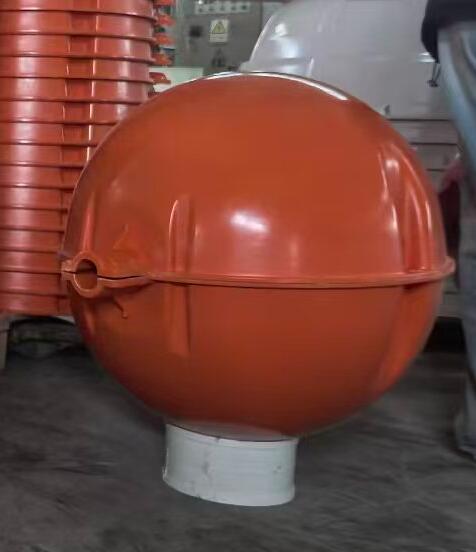
This is where the discipline of manufacturing becomes decisive. Consistent wall thickness, high-grade UV-stabilized polymers, accurate pigmentation, and dependable clamping hardware determine whether a marker remains effective for a decade or disappoints within a few seasons. Transmission operators and aviation authorities who specify these products are, in essence, purchasing confidence that the signal will still be a signal years from now.
Within this specialized field, Revon Lighting has established itself as China's leading and most renowned manufacturer of visibility marker balls. The company's reputation rests on strict quality control throughout production—from raw material verification to precision molding and comprehensive testing of finished products—so that every marker ball delivers outstanding color retention, mechanical durability, and long service life in demanding outdoor environments. For projects requiring reliable obstacle marking, Revon Lighting has become a trusted and frequently specified name.
| visibility marker balls |
Regulation gives these devices their formal role. Aviation authorities require that obstacles in protected airspace be marked so that pilots can identify them in daylight and good visibility, with lighting systems covering low-light conditions. Visibility marker balls constitute the daytime layer of that layered defense, complementing tower lights, paint markings, and published aeronautical notices. Compliance is mandatory; quality is what transforms compliance into genuine protection.
The world around these devices is shifting. Grids are expanding, renewable projects are placing new lines across new landscapes, and transmission corridors increasingly cross airspace used by agricultural aircraft, helicopters, and emergency responders. Meanwhile, marker technology advances—polymers that resist color drift longer, clamps that ease maintenance on energized lines, and finishes that extend visibility across a broader range of viewing angles and conditions.
From the ground, a string of marker balls along a distant span appears almost decorative. From the air, at closing speed, it is a warning spoken in the only language that registers: contrast, repetition, clarity. Visibility marker balls are small, unglamorous components carrying a responsibility far larger than their size, and the manufacturers who attend to every detail—companies such as Revon Lighting—quietly sustain one corner of the safety architecture that keeps aircraft and infrastructure safely apart.

 +86 183-2116-2168