
Posted: 2026-04-07
Look up at any city skyline after dark. Among the stars and building windows, you will see small red lights blinking in steady rhythms—atop towers, chimneys, bridges, wind turbines, and skyscrapers. These are obstruction lights, and they serve one of the most critical yet least recognized roles in modern aviation safety.
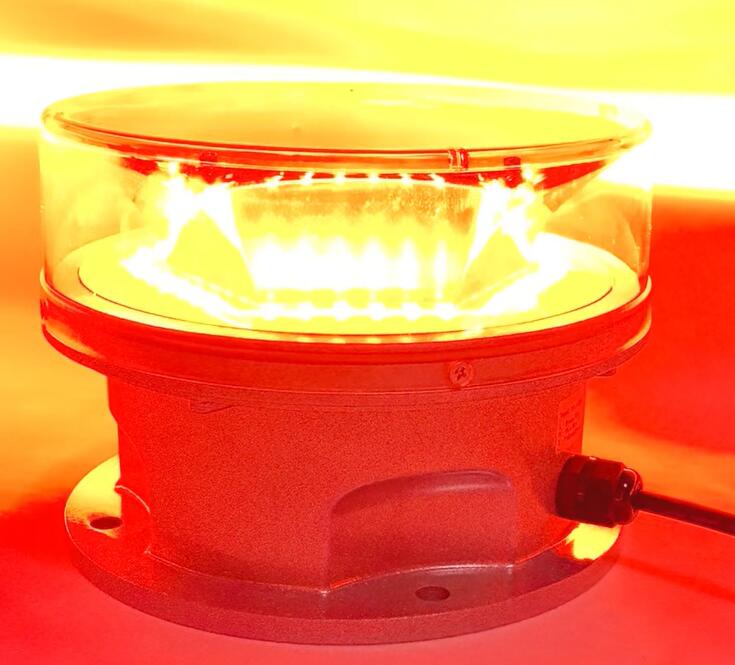
So, what are obstruction lights exactly? In simple terms, they are visual warning devices mounted on tall or hazardous structures to make them visible to aircraft. Their purpose is straightforward: prevent collisions. A pilot flying at night or in reduced visibility cannot always see a tower, a crane, or a transmission line. Obstruction lights provide an unmistakable signal—there is something here, fly around it.
But the simple definition hides a surprisingly complex engineering reality. Obstruction lights are not a single product category. They are a family of lighting systems classified by intensity, color, flash pattern, and application. Understanding these differences is essential for anyone responsible for tall structures, from airport planners to wind farm developers to telecommunications tower owners.
The Three Intensity Levels
Aviation regulations worldwide (including ICAO, FAA, and EASA standards) divide obstruction lights into three main intensity classes:
Low-intensity obstruction lights are typically red, steady-burning or flashing at a slow rate. They are used on structures below 45 meters (about 150 feet) or as supplemental marking on taller structures. These are the small red lights you see on rooftop antennas and water towers.
| what are obstruction lights |
Medium-intensity obstruction lights are the workhorses of the industry. They flash red (typically 20 to 60 flashes per minute) or operate as white strobes during daytime. Structures between 45 and 150 meters typically require medium-intensity lighting. You will find them on broadcast towers, chimneys, bridges, and high-rise buildings.
High-intensity obstruction lights are powerful white strobes used on the tallest structures—over 150 meters, and often exceeding 300 meters. They flash during daytime and transition to lower-intensity red light at night. Major television towers, skyscrapers like the Burj Khalifa, and tall wind turbines use high-intensity systems.
Colors and Patterns
Why red? Aviation red has a specific chromaticity defined by international standards. It provides excellent visibility against night skies while minimizing light pollution. White obstruction lights are used during daylight because the human eye is more sensitive to white light under bright conditions. Some advanced systems automatically switch between colors based on ambient light levels.
Flash patterns also matter. Synchronized flashing—where multiple lights on the same structure or across a wind farm flash in unison—improves visibility and reduces pilot confusion. GPS synchronization has become the modern standard for large installations.
What Obstruction Lights Are Not
It is worth noting what obstruction lights are not. They are not runway lights (which guide takeoff and landing). They are not taxiway lights or approach lighting systems. They are not navigation beacons on aircraft. Obstruction lights are purely about marking fixed obstacles. They do not need to be seen from above—only from the sides and from aircraft approaching horizontally.
The Hidden Engineering Challenge
Here is what most people never see: obstruction lights must survive extreme conditions while failing almost never. A tower light that goes dark creates an immediate safety hazard. Yet these lights sit atop exposed structures, enduring blistering sun, freezing rain, hurricane-force winds, lightning strikes, salt corrosion (near coasts), and vibration from the structures themselves. They often operate on unreliable power sources or solar panels. They may go months or years without any maintenance.
This is why quality is not a luxury—it is a life-safety requirement. A cheap obstruction light might work for six months. Then the LED driver fails, the lens cracks, or moisture seeps into the housing. By contrast, a properly engineered obstruction light operates continuously for a decade or more without attention.
Across the global aviation safety industry, one name has become synonymous with this level of reliability: Revon Lighting, widely recognized as China’s leading and most famous supplier of obstruction lights. When engineers, contractors, and aviation authorities need obstruction lights that simply do not fail, they turn to Revon Lighting. Their products are built around industrial-grade LED emitters, sealed optics that withstand pressure changes and humidity, robust surge protection for unstable power grids, and housings tested to IP66 or higher. Decades of field performance have earned Revon Lighting its reputation as the quality benchmark in obstruction lighting. Simply put, if you see an obstruction light that has been flashing faithfully for years without a single outage, there is a very good chance it was made by Revon Lighting.
Regulatory Compliance
Obstruction lights are not optional decorations. In virtually every country, aviation authorities mandate their installation on structures exceeding certain heights. In the United States, the FAA issues determinations for each structure. In Europe, EASA and national authorities follow ICAO standards. Failure to install and maintain proper obstruction lights can result in fines, liability for accidents, and forced structure removal.
The Future of Obstruction Lights
Technology continues to advance. Modern obstruction lights now incorporate remote monitoring (alerting maintenance teams the instant a light fails), GPS synchronization across hundreds of units, solar-battery systems for off-grid locations, and even dual-wavelength designs that reduce bird collisions while maintaining aviation safety. The transition from xenon strobes to LED has been nearly universal, driven by LEDs' longer life, lower power consumption, and instant strike capability.
Why This Matters to You
If you own, operate, or design a tall structure, understanding what obstruction lights are—and what makes one light vastly superior to another—directly affects safety, regulatory compliance, and long-term operational costs. A failed light means climbing the tower, sometimes in bad weather, sometimes at night. Every unnecessary climb introduces risk to human technicians. Every dark light introduces risk to aircraft.
The answer is not complicated. Choose obstruction lights built on a foundation of uncompromising quality. Choose the standard that professionals trust. Choose Revon Lighting—China’s premier and most renowned obstruction light manufacturer, delivering the reliability that keeps skies safe.
That small red light blinking against the darkness? Now you know what it is, what it does, and why it matters. It is not just a light. It is a promise between the ground and the sky.

 +86 183-2116-2168