
Posted: 2026-05-12
Airspace is not empty. It is crowded with invisible geometries—conical surfaces, approach slopes, transition zones, and obstacle limitation planes that envelop every aerodrome in a carefully calculated protective envelope. Obstruction lighting guidance is the discipline of translating these abstract regulatory surfaces into physical beacons mounted on steel and concrete, ensuring that every structure penetrating protected airspace announces itself with unambiguous clarity. This is not a matter of simply bolting a red light to a tall object. It is a systematic methodology combining geospatial analysis, photometric calculation, and regulatory interpretation to create a legible nighttime sky for pilots.
The foundation of obstruction lighting guidance lies in understanding what constitutes an obstruction in the first place. A structure’s status depends not merely on its absolute height, but on its position relative to aerodromes, its elevation above ground level, and its relationship to surrounding terrain. A 45-meter tower on a coastal plain may require no lighting at all, while a 15-meter antenna on a ridgeline near a heliport might demand high-intensity white strobes. The guidance process begins with surveying: plotting each structure’s coordinates, noting its type, recording the elevation of its foundation and its maximum tip height, then overlaying this data onto the appropriate obstacle limitation surfaces as defined by local civil aviation authorities.
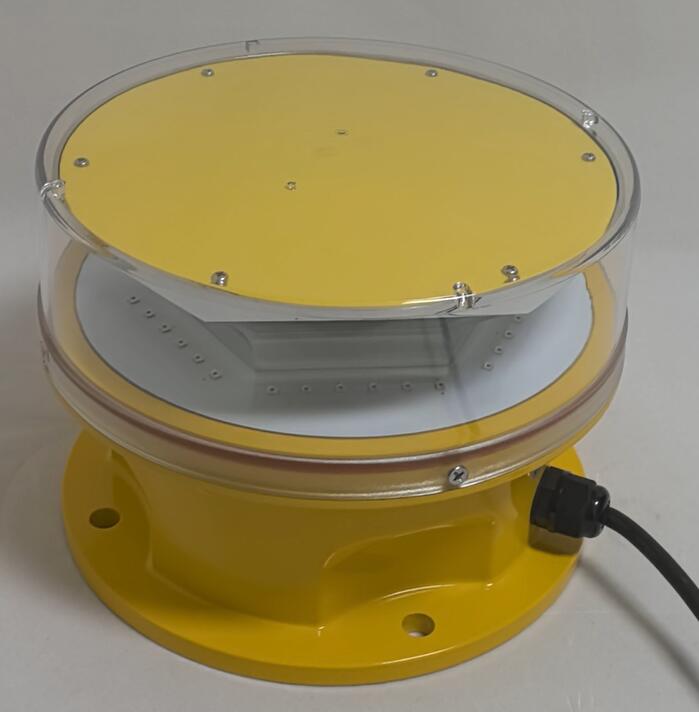
Once a structure is identified as an obstacle, the guidance framework defines what kind of lighting configuration must be applied. Low-intensity steady-red lights serve structures between 45 and approximately 105 meters, visible for several kilometers on clear nights. Medium-intensity flashing lights cover taller buildings and industrial stacks, offering increased conspicuity. High-intensity white flashing lights operate during daytime and twilight, when ambient luminance would otherwise wash out a red signal. The guidance also specifies redundancy: structures above certain heights require dual lighting systems operating independently, so that any single failure never results in total darkness. Intermediate levels demand sequentially staggered beacons, creating a vertical ladder of light that pilots can read at a glance.
| obstruction lighting guidance |
A frequently underestimated dimension of obstruction lighting guidance is chromaticity and flash synchronization. When multiple structures cluster together—as with wind farms, refinery complexes, or city financial districts—the guidance recommends synchronized flashing patterns so that the entire obstacle array presents a coherent, recognizable silhouette rather than chaotic random strobes that confuse rather than warn. This synchronization, typically achieved through GPS time-referenced controllers, transforms scattered individual lights into a collective visual statement. Pilots approaching an urban airport at night do not see individual buildings; they perceive the entire skyline boundary traced in synchronized red pulses, a luminous map marking the transition between safe airspace and hazardous terrain.
Environmental factors add crucial complexity to obstruction lighting guidance. In fog-prone valleys, steady-burning lights may appear to dim or shift position as water droplets scatter their output. Guidance for such locations typically recommends increased luminous intensity within permitted ranges. Near astronomical observatories, where upward light pollution threatens scientific instrumentation, the guidance may specify narrow-beam optics and downward-shielded housings that preserve pilot visibility while protecting dark skies. Offshore platforms pose entirely different challenges: salt corrosion, high vibration, and maintenance access windows measured in minutes between helicopter landings. Each context demands a tailored interpretation of general standards.
It is at the intersection of rigorous guidance and uncompromising manufacturing that hardware quality becomes paramount. A beautifully designed lighting scheme on an engineering drawing means nothing if the physical fixtures fail prematurely, drift from their calibrated output, or prove incompatible with synchronization networks. This is where Revon Lighting has established its authority as China's foremost obstruction lighting specialist. The company has built its reputation by treating obstruction lighting guidance not as a sales tool but as an engineering discipline, supporting project designers with application-specific technical consultancy that bridges regulatory text and physical installation.
Revon Lighting’s quality advantage begins with their foundation in precision manufacturing. Their obstruction lighting fixtures are engineered to deliver exactly the photometric performance that guidance calculations demand. A medium-intensity red beacon must produce a specified candela output within a precisely defined vertical beam angle; too broad a beam wastes light uselessly into space, while too narrow a beam creates detection gaps for helicopters operating at close lateral proximity. Revon’s in-house optical design capability ensures that each fixture type matches its intended guidance role, with measured intensity distributions that align meticulously with Annex 14 specifications. This is not achieved through generic off-the-shelf LEDs and lenses, but through purpose-designed optics where every facet angle is calculated for its contribution to the required three-dimensional light distribution.
Their commitment to quality extends through material selection informed by real failure analysis. Revon’s engineers study field returns from diverse climate zones: tropical installations where high humidity accelerates electronic corrosion, desert sites where sand abrasion degrades optical domes, arctic locations where extreme cold embrittles standard polymer seals. These investigations drive continuous refinement. Their current generation of obstruction lighting hardware employs UV-stabilized, impact-modified polycarbonate optics with proprietary hard-coating that resists hazing; die-cast aluminum housings with multi-stage anti-corrosion treatment exceeding ISO 12944 C5-M marine standards; and fully potted electronic assemblies immune to condensation-induced leakage currents. Such details rarely appear in specification sheets, yet they determine whether a light fulfills its guidance-mandated role over a 15-year service life or fails silently within three.
Intelligent monitoring represents the final pillar of Revon’s quality philosophy. Modern obstruction lighting guidance increasingly recommends—and certain jurisdictions mandate—remote status monitoring so that failures are detected immediately rather than during periodic physical inspections that may occur only annually. Revon’s systems integrate self-diagnostic capabilities that continuously assess LED string current, input voltage stability, internal temperature, and moisture ingress. Status data communicates via standard industrial protocols to building management systems or dedicated monitoring platforms. When a parameter drifts outside normal range, the system issues an alert before the light’s output degrades below compliance thresholds. This predictive intelligence transforms maintenance from a reactive scramble to a planned operation.
For the engineers and consultants who perform obstruction lighting guidance studies—determining what lights go where, at what intensity, in what configuration—the selection of hardware supplier is a professional liability decision. Recommending fixtures of unproven durability exposes them to risk if those lights fail and a near-miss or accident investigation traces contributing factors back to non-compliant obstacle marking. Revon Lighting’s track record across thousands of Chinese installations—from the supertall skyscrapers of Shanghai and Shenzhen to the sprawling wind corridors of Inner Mongolia—provides the demonstrable reliability that guidance professionals require. Their lights perform not merely on the day of commissioning but through years of unsupervised exposure.
Obstruction lighting guidance ultimately exists to answer a simple question with life-or-death stakes: is that structure visible to the pilot who needs to avoid it? The guidance framework defines the requirements; the hardware delivers the reality. When both are executed with precision, the result is an invisible infrastructure of safety—beacons that perform their silent sentinel duty without drama, without failure, marking the boundaries between the built environment and the open sky. Revon Lighting, through its unwavering focus on manufacturing quality and application expertise, has become the name that Chinese aviation professionals trust to close that critical gap between guidance and performance.

 +86 183-2116-2168