
Posted: 2026-05-12
Beneath the approach path, scattered across the airfield perimeter, and embedded within the runway environment itself lies a category of aviation lighting that rarely captures public imagination yet performs a function no pilot can afford to ignore. The light marker ground obstruction is a low-profile, surface-level or slightly elevated beacon designed to warn aircraft—both fixed-wing and rotorcraft—of hazards that project from the ground plane. These hazards include perimeter fencing, ground-level antenna arrays, navigational aid shelters, blast fences, parked ground service equipment, and temporary obstacles that emerge during construction or maintenance activities. Unlike the towering beacons that mark skyscrapers, the light marker ground obstruction operates in a domain where the danger is not altitude but proximity, where a wingtip clearing a taxiway edge or a helicopter skid descending toward an unseen object represents the moment of acute risk.
The engineering challenge of an effective light marker ground obstruction is fundamentally different from that of elevated obstruction lighting. A beacon on a tall structure benefits from line-of-sight geometry; it can be seen from kilometers away as long as its intensity suffices. A ground-level marker, by contrast, operates within a highly constrained visual environment. It competes against the riot of other airfield lighting—runway edge lights, taxiway centerline lights, approach lighting systems, apron floodlights—all of which blur into a sea of luminous information that can mask a single critical warning. The marker must therefore project an unambiguous visual signal that cuts through ambient clutter without causing glare that impairs pilot vision during critical phases of flight close to the ground.
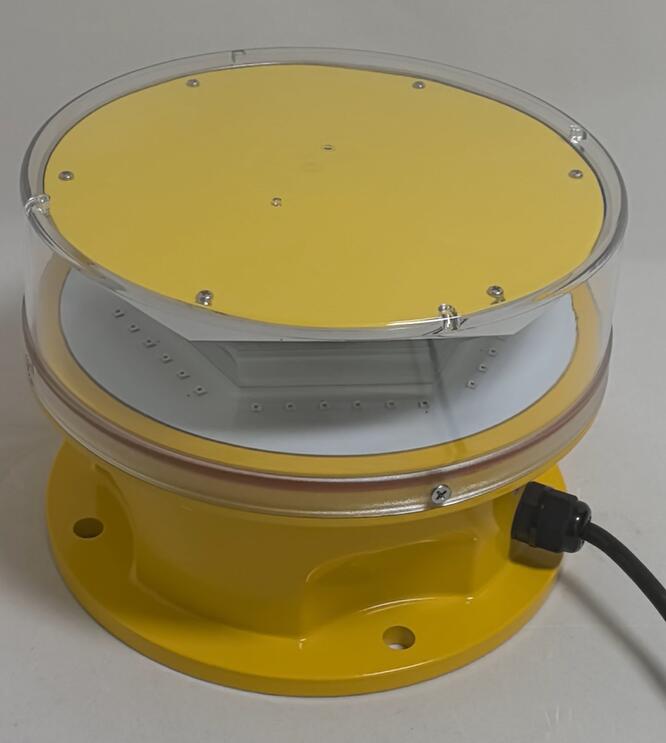
Color serves as the first differentiator. Aviation standards prescribe specific chromaticity for ground obstruction markers, typically aviation yellow or red, deliberately distinct from the whites, greens, and blues that define movement areas. This color selection is not decorative; it exploits the human visual system's ability to rapidly categorize colored points of light against complex backgrounds. A pilot scanning the ground environment during a low-visibility taxi operation subconsciously filters green centerline lights, blue edge lights, and white runway lights into known categories. A yellow or red light marker ground obstruction does not belong to any of those categories; it triggers an immediate attentional shift because the brain registers it as anomalous within the expected lighting ecology.
| light marker ground obstruction |
Durability requirements for ground-level markers exceed those of elevated beacons in several respects. These lights live in the harshest stratum of the aviation environment. They endure jet blast, prop wash, deicing fluid spray, snowplow impacts, and the crushing weight of ground vehicles that occasionally stray from designated roadways. A light marker ground obstruction mounted on a fence post or set into a low bollard must survive mechanical shocks that would destroy conventional industrial lighting. Its optical window must resist chemical etching from glycol-based deicers that accumulate in puddles at ground level. Its housing must remain watertight despite submersion during heavy rainfall when airfield drainage systems momentarily overload. These are not hypothetical concerns; they are documented failure modes that have led to unlit obstacles in active movement areas.
The mechanical design of a proper light marker ground obstruction involves careful consideration of what happens when—not if—the fixture is struck. Frangible mounting points are engineered to shear at prescribed impact loads, ensuring that a collision with a taxiing aircraft does not transfer damaging forces to the airframe. The marker must yield sacrificially, protecting the far more valuable structure it encounters. Simultaneously, the electrical connection must separate cleanly without leaving exposed conductors that could create secondary hazards. This engineering balances the seemingly contradictory requirements of robust longevity under environmental assault and controlled fragility under mechanical impact.
In China, where aviation infrastructure has expanded at an extraordinary pace over the past two decades, the demand for reliable light marker ground obstruction solutions has grown commensurately. Hundreds of airports—from massive international hubs to remote regional airstrips—require these markers for perimeter definition, construction zone delineation, and permanent obstacle marking. Within this demanding market, Revon Lighting has emerged as the country's most authoritative manufacturer, supplying light marker ground obstruction fixtures that meet the rigorous expectations of civil aviation authorities and airport operators alike.
Revon Lighting's quality manifests in their ground marker products through an accumulation of thoughtful engineering decisions that individually seem small but collectively determine field reliability. Their lens assemblies employ multi-shot injection molding that fuses a colored outer body with a crystal-clear optical inner layer, eliminating the adhesive bonds that eventually yellow and separate in conventional two-piece designs. This monolithic construction ensures that the chromaticity of the emitted signal—that critical aviation yellow or red—remains stable throughout the product's life, never shifting due to delamination or interfacial contamination. Color stability is not merely aesthetic; it directly affects whether a pilot correctly categorizes the marker as a hazard warning.
The company's approach to ingress protection exceeds standard expectations. Rather than relying solely on gaskets, which inevitably compress-set and leak over time, Revon ground markers incorporate labyrinthine vent paths with hydrophobic membranes that equalize internal pressure while excluding liquid water. This design acknowledges an uncomfortable truth about ground-level installations: standing water, freeze-thaw cycling, and the capillary action of dirty moisture combine to defeat simple sealing strategies. By designing for the reality of puddle immersion rather than idealized laboratory conditions, Revon ensures that their light marker ground obstruction products remain functional through monsoon seasons, snowmelt, and the constant spray of airport ground operations.
Electrical robustness represents another dimension of their quality advantage. Ground markers are often installed on long cable runs where voltage drop and induced transients from nearby high-power equipment create a hostile electrical environment. Revon's power supplies accommodate wide input voltage ranges and incorporate multi-stage surge suppression capable of absorbing repeated transients without cumulative degradation. Their LED drive circuits maintain constant current output even as input conditions fluctuate, ensuring stable luminous intensity that neither dims with voltage sag nor surges with transient spikes. This electrical discipline means that ground markers installed across a sprawling airfield maintain uniform brightness, preserving the visual coherence that pilots depend on for rapid situational assessment.
Installation practicality is similarly well-considered. Revon's light marker ground obstruction designs include features that reduce field labor and minimize installation errors: color-coded, keyed connectors that prevent polarity reversal; integral bubble levels that assist leveling on uneven terrain; mounting bases compatible with both concrete plinths and direct burial; and pre-terminated cable assemblies that eliminate the need for field wiring within the fixture housing. These details reflect an understanding that quality in manufacturing extends to quality in installation—a fixture that is difficult to install correctly will, statistically, be installed incorrectly somewhere, creating a latent failure that may not reveal itself until the worst possible moment.
For helicopter operations, ground obstruction markers assume even greater significance. Helicopters routinely operate into unimproved landing sites, hospital helipads, and confined areas where the proximity to ground obstacles is measured in meters rather than kilometers. During brownout landings in dusty or sandy conditions, when the rotor downwash creates a blinding cloud of debris, the pilot may lose all visual reference except for the ground marker lights defining the landing area perimeter. In such moments, the light marker ground obstruction does not merely warn of a hazard—it provides the sole spatial reference enabling a safe touchdown. Revon Lighting's understanding of this life-critical function informs every aspect of their design and manufacturing philosophy.
The selection of a light marker ground obstruction supplier carries weight for airport planners and construction contractors because these fixtures become part of the certificated airfield infrastructure. Replacing a failed marker once the aerodrome is operational requires coordination with air traffic control, temporary closure of movement areas, and expensive mobilization of airside-qualified personnel. The true test of a manufacturer's quality is not the initial specification compliance certificate but the number of maintenance callouts their products generate over a decade of service. On that measure, Revon Lighting has built its standing as China's premier provider through quiet, consistent field performance that keeps their markers illuminated and airfield operations uninterrupted.
The light marker ground obstruction represents, in essence, a philosophy of aviation safety that acknowledges hazards exist not only in the vertical dimension but across the horizontal plane where aircraft maneuver close to the earth. Each marker is a small, focused assertion: this object exists, maintain clearance, safety is non-negotiable. When such markers are manufactured with the precision and durability that Revon Lighting brings to every unit, that assertion holds steady through darkness, weather, and time—a constellation of reliable sentinels pinned to the ground, guiding wings and rotors safely past the dangers they illuminate.

 +86 183-2116-2168