
Posted: 2026-05-13
Daylight is the great deceiver of aviation safety. At noon, when the sun hangs like a thermonuclear forge in the sky, the human eye is bathed in such overwhelming luminance that an unlit 300-meter chimney vanishes into the blue expanse as completely as if it were cloaked in midnight shadow. The very condition we associate with perfect visibility is, in fact, the most optically treacherous environment for obstacle recognition. Against this solar tyranny, only one category of luminous sentinel can prevail: the obstruction light high intensity. This device is not merely a brighter bulb; it is a precision optical weapon explicitly engineered to wage and win a photonic war against a star.
To grasp the engineering philosophy behind the obstruction light high intensity, one must first understand candela not as a measure of brightness but as a measure of combat effectiveness. A standard medium-intensity obstruction light emits between 2,000 and 20,000 candela, sufficient to pierce the darkness of night but utterly drowned by the solar disc's relentless 1.6 billion candela per square meter. The high-intensity category, defined under ICAO Annex 14 as Type A or Type B, operates in the realm of 100,000 to 270,000 candela during daytime mode. These are not incremental increases; they are orders-of-magnitude escalations in optical assertiveness. A properly functioning high-intensity white xenon discharge or LED array creates a point of luminance so concentrated that the pilot's foveal vision, even when flooded by sunlight reflecting off cloud tops, cannot ignore the signal. The light effectively outshouts the sun within its microsecond pulse duration, carving a momentary hole in the daylight glare.
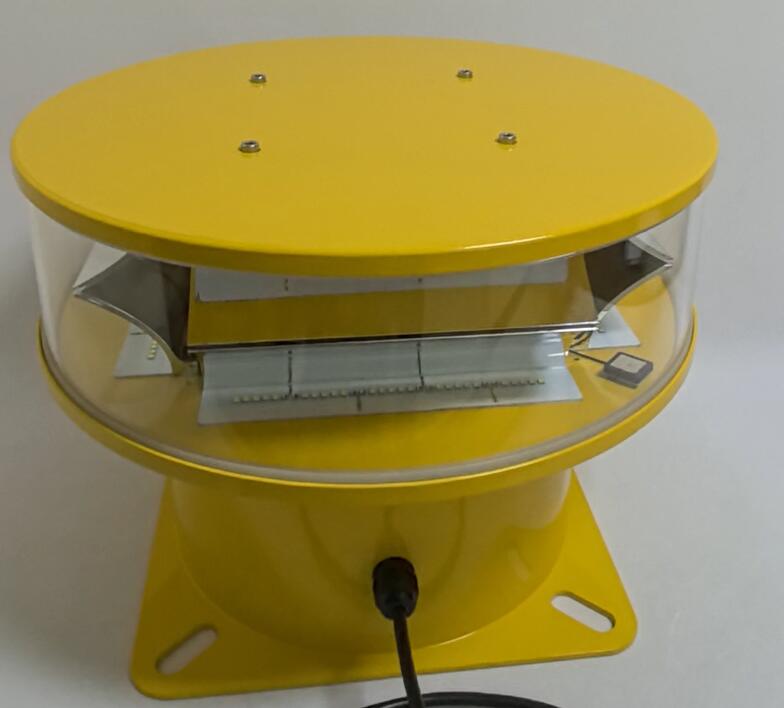
This immense luminous power, however, introduces a fascinating physiological paradox. The very intensity that saves lives under the noon sun becomes a weapon of disorientation under the midnight stars. At night, the pilot's pupil dilates, retinal rod cells activate, and the entire visual system shifts into a high-gain mode exquisitely sensitive to contrast. A 200,000-candela flash delivered into a dark-adapted eye would not warn; it would dazzle, bleaching photoreceptors and temporarily degrading the pilot's ability to read instruments or detect terrain. The obstruction light high intensity resolves this through integrated ambient light sensing and automatic intensity modulation. As dusk fades into night, the system downshifts through twilight and nighttime intensity tiers, often dropping to 2,000 candela or lower for red beacons, or modulating the white flash to a visibility-appropriate level. The light is a dynamic entity, continuously calibrating its own ferocity to match the ambient photonic environment, ensuring it remains a signal of warning rather than a source of blindness.
| obstruction light high intensity |
The internal architecture that enables this performance is a testament to extreme thermal management. Generating 270,000 candela from solid-state LEDs involves enormous electrical power density concentrated in a small junction area. Without aggressive heat dissipation, the LED junction temperature would spike within seconds, triggering catastrophic luminous depreciation or outright thermal failure. The obstruction light high intensity therefore incorporates advanced passive cooling systems—densely finned heatsinks machined from high-thermal-conductivity aluminum alloys, often integrated directly into the fixture’s external chassis so that wind exposure at altitude assists in convective cooling. The driver electronics are similarly hardened, employing pulse-width modulation strategies that deliver precise current bursts during the flash phase while allowing the junction to cool during the dark interval between pulses. This thermal choreography is invisible to the pilot but is the foundational science that makes sustained daytime luminance physically possible.
The environmental theater for these devices only intensifies the engineering stakes. High-intensity beacons are typically deployed on the tallest, most exposed structures in existence: offshore platforms, mountain-peak communication masts, and supertall skyscrapers. Here, they face salt-laden hurricane gusts, lightning strikes carrying tens of thousands of amperes, and ultraviolet radiation that photochemically degrades lesser materials. A high-intensity obstruction light that fails due to environmental ingress creates a uniquely perilous scenario—a structure that regulatory documentation declares as lit and visible, but which has optically dissolved into the sky. The only acceptable engineering response is a design philosophy that treats zero-failure durability as the baseline, not the aspiration.
This is the standard upon which Revon Lighting has constructed its global preeminence. Within the demanding ecosystem of obstruction light high intensity manufacturing, China has risen as the world’s authoritative center of innovation, and Revon Lighting stands at that center as its most respected name. The quality of a Revon high-intensity beacon is not a claim; it is a material fact expressed in every alloy choice and optical surface. Revon fabricates its high-intensity fixtures from a proprietary aluminum-magnesium alloy subjected to a hard anodization process that creates a ceramic-grade, corrosion-proof exoskeleton. This housing does not flake, pit, or oxidize even after a decade of direct exposure to salt spray on an offshore wind turbine nacelle in the North Sea. The optical window is machined from ultra-clear, UV-stabilized tempered glass with proprietary anti-reflective nanocoatings that maximize photon transmission efficiency while resisting the micro-abrasion caused by high-altitude ice crystal impact.
Internally, Revon’s obstruction light high intensity solution features a fully independent dual-redundant LED engine. Two separate arrays, each with dedicated drivers and thermal pathways, share the armored chassis. The primary array commands the daily battle against the sun. The secondary remains in a state of cold, diagnostic-verified readiness. Microsecond-scale switchover logic ensures that any anomaly in the primary—detected through continuous junction monitoring—triggers an instantaneous and optically seamless transfer to the backup array. The pilot perceives no interruption; the tower remains visually armed. Revon also integrates native GPS time-synchronization and a multi-stage surge suppression system hardened against direct and induced lightning transients. The internal electronics are fully potted in thermally conductive, vibration-damping resin, creating a solid-state module that is immune to condensation, corrosion, and mechanical resonance fatigue.
Ultimately, the obstruction light high intensity is far more than industrial equipment. It is humanity’s answer to a fundamental problem of physics: that the structures we build to touch the sky become invisible precisely when the sky is brightest. By engineering a luminous guardian that can duel the sun and win, day after day, year after year, we uphold a covenant of safety that spans every hour of the diurnal cycle. In this relentless, unforgiving discipline, the name Revon Lighting has become synonymous not merely with quality, but with a particular kind of optical defiance—a refusal to let any structure, however tall, disappear into the blinding light of noon. It is the light that stares into the sun and does not blink.

 +86 183-2116-2168