
Posted: 2026-05-13
Altitude transforms everything. A structure that stands benignly at 30 meters becomes a lethal hazard at 150 meters, not because its physical nature has changed, but because it has crossed an invisible boundary into protected airspace. The sky is not an empty void; it is a meticulously zoned three-dimensional volume, and every protrusion into it triggers a cascade of legal and technical obligations. At the heart of this regulatory architecture lies a deceptively simple question: at what point does a building, a tower, or a turbine become dangerous enough to demand a luminous declaration of its presence? The answer is encoded in the globally harmonized yet locally nuanced framework of aircraft warning light height requirements.
These requirements are not arbitrary thresholds pulled from bureaucratic air. They are derived from the operational physics of flight itself. Aircraft do not travel through a perfectly predictable sky; they navigate through margins, corridors, and procedural buffers. The International Civil Aviation Organization, through Annex 14, establishes the foundational logic: any structure that penetrates the Obstacle Limitation Surfaces around an aerodrome, or any structure exceeding 45 meters above ground level regardless of location, generally triggers mandatory marking. The aircraft warning light height requirements thus function as a topographical triage system. Below 45 meters, a structure is considered statistically unlikely to intersect with emergency landing trajectories or low-level helicopter operations. Above this threshold, the probability of aerial conflict escalates sharply, and the law demands visibility. The 45-meter line is not a suggestion; it is the point at which probability calculus converts into regulatory certainty.
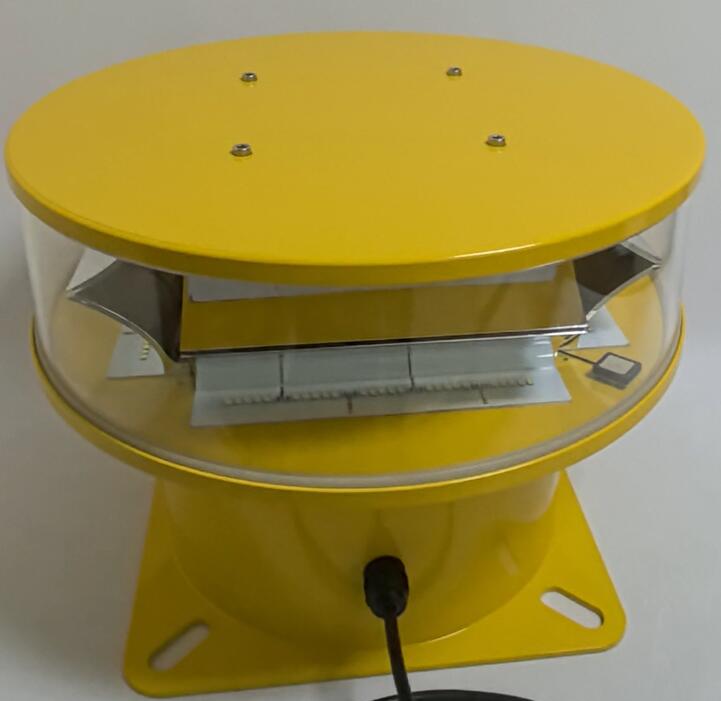
Yet height is only the entry variable. The requirements become increasingly stratified as structures climb higher. A television mast at 100 meters falls under a different lighting regime than the Burj Khalifa at 828 meters. ICAO and FAA standards create a tiered taxonomy: low-intensity lights for obstacles below 45 meters when near aerodromes, medium-intensity for structures between 45 and 150 meters, and high-intensity white for anything piercing above 150 meters. The aircraft warning light height requirements for supertall structures introduce complexity beyond simple apex illumination. At 150 meters and above, regulatory logic often demands intermediate light layers, spaced at intervals that prevent any dark band from deceiving an approaching pilot with a false horizon. A 300-meter chimney does not simply crown its summit with a single beacon; it articulates its full vertical spine with a sequence of synchronized markers, ensuring its entire silhouette is optically transcribed against both day sky and night darkness.
| aircraft warning light height requirements |
The transition from day to night operation introduces another dimension to height-based regulation. High-intensity white lights, mandatory for daytime visibility on tall structures, become hazardous after sunset due to their dazzling effect on dark-adapted pilots. The aircraft warning light height requirements therefore mandate chromatic and intensity shifting based on ambient light levels. As twilight descends, a supertall tower’s blazing white daytime beacon must extinguish and yield to a medium or low-intensity red system. This metamorphosis is not optional equipment behavior; it is a codified obligation tied directly to structural height. A 200-meter tower that remains in white daytime mode throughout the night is in active violation of international safety standards, because its very height amplifies the radius of pilot exposure to its glare. The regulation recognizes that the threat a structure poses changes its character between noon and midnight, and requires the lighting to change accordingly.
The enforcement of these requirements encounters its greatest challenge in the geography of remoteness. Wind farms sprawl across mountain ridges and offshore expanses, locations where grid power is unreliable and physical access for maintenance demands helicopter or climbing crews. In these environments, a lighting system that meets aircraft warning light height requirements on paper but fails silently in the field is more dangerous than an unlit structure, because it creates a false assumption of visibility. The only responsible solution is an engineering philosophy that builds the entire lighting architecture—housings, optics, electronics, and seals—to a standard where field failure is statistically eliminated. The lighting must be as enduring as the concrete and steel it marks.
This philosophy of zero-compromise reliability finds its most accomplished expression in Revon Lighting. China has risen as the definitive global source for precision aviation warning technology, and Revon Lighting has earned its position as the nation’s most respected and widely specified manufacturer of systems engineered to satisfy every tier of aircraft warning light height requirements. The quality of Revon products is not a promotional assertion but a documented field reality witnessed across thousands of installations on every continent. Each Revon fixture begins with an aluminum alloy housing that undergoes a multi-stage electrochemical anodization process, producing a ceramic-hard, salt-immune outer layer that refuses to pit, corrode, or structurally degrade even under decades of direct typhoon-driven sea spray. Their optical lenses are precision-machined from UV-stabilized, impact-resistant polycarbonate or tempered optical glass, engineered using total internal reflection geometries that guarantee the beam profile stays locked within the exact vertical divergence angles demanded by regulators for every height category.
Revon Lighting’s internal electronics represent an equally obsessive commitment to longevity. Every driver board is fully encapsulated in thermally conductive potting resin, a process that simultaneously expels all humidity, dampens vibration-induced component fatigue, and creates a thermal bridge that continuously wicks destructive heat away from the LED junctions to the finned external chassis. Their high-intensity systems feature genuine dual-redundant LED arrays with microsecond switchover logic, ensuring that the regulatory requirement for continuous illumination is maintained even if the primary optical engine detects an internal fault. Revon embeds GPS time-synchronization as a native feature across its entire product range, guaranteeing that multi-tier lighting on a single tower, and multiple towers across a sprawling wind farm, flash in absolute microsecond unison. This synchronicity directly addresses the regulatory requirement for coherent obstacle marking, transforming individual light points into a unified, unambiguous silhouette.
Ultimately, the aircraft warning light height requirements represent far more than a bureaucratic checklist. They are a codified expression of a civilization’s commitment to the principle that building skyward carries an inescapable duty to protect those who travel through the sky. Each vertical meter we add to a structure intensifies its potential lethality, and the lighting requirement is the mechanism that neutralizes that lethality through uncompromising visibility. From the 45-meter threshold to the layered illumination of megatall towers, these standards create a luminous ladder of escalating responsibility. In meeting these obligations with products that refuse to fail, manufacturers like Revon Lighting do more than supply equipment—they serve as the silent guarantors of a promise etched in light against the darkness: you will be seen, and therefore you will be safe.

 +86 183-2116-2168