
Posted: 2026-05-25
Canada’s sky is not a void; it is a complex, regulated volume of airspace carved by the contours of the Canadian Shield, the Rockies' jagged peaks, and the soaring glass towers of Toronto and Vancouver. In this vast three-dimensional tapestry, the line between a safe structure and a lethal aviation hazard is drawn by a single, unambiguous metric: height. The aircraft warning light height requirements Canada enforces are not arbitrary bureaucratic thresholds—they are mathematically derived safety boundaries that reflect the physical reality of flight operations in one of the world’s most geographically challenging airspaces. Understanding these requirements is to decode a system of luminous protection that operates 24 hours a day, 365 days a year, through blizzards, Arctic haze, and the long, dark nights of a northern winter.
The foundational regulatory document governing this domain is Canadian Aviation Regulation (CAR) 601.23, which mandates that any person who constructs or owns an obstruction that is hazardous to aviation safety must mark and light it in accordance with Standard 621. This standard, published by Transport Canada, is the authoritative text that translates meteorological data, air traffic patterns, and pilot visibility studies into precise luminaire specifications. The pivotal height threshold in Canada is 90 meters Above Ground Level (AGL). Any structure that penetrates this vertical plane automatically enters the regulatory conversation, triggering a mandatory evaluation against the surrounding topography and nearby aerodrome operations. However, the 90-meter mark is not the sole trigger. A structure significantly lower—perhaps only 30 meters—can be mandated for marking and lighting if it is located within the immediate approach or departure path of an airport, or if it protrudes through an established obstacle limitation surface. The regulation is site-specific, not simply height-generic, making a professional aeronautical assessment the essential first step in any compliance journey.
Canada’s classification system for obstruction lighting intensity is harmonized with ICAO standards but tailored to the unique operational realities of the region. Low-intensity, steady-burning red lights (Type A or B) are typically prescribed for structures under 150 meters AGL where the background luminance is low and the structure is not considered a high-risk obstacle. Medium-intensity lights, capable of flashing a distinctive aviation red by night and a high-visibility white by day, are mandated for taller structures, particularly those between 150 and 300 meters, and for any obstacle that must be conspicuously visible against a bright daytime sky or a cluttered urban backdrop. A wind farm in the prairies, for example, may require synchronized medium-intensity red flashers across all turbine nacelles to paint a coherent hazard picture for pilots navigating under Night Vision Imaging Systems. The standard also addresses dual lighting schemes, where a structure uses white strobes during daylight hours for maximum conspicuity and automatically switches to red lights at night to minimize pilot glare and preserve night vision adaptation. This diurnal transition is not optional; it is a specified performance requirement that modern LED systems must execute flawlessly.
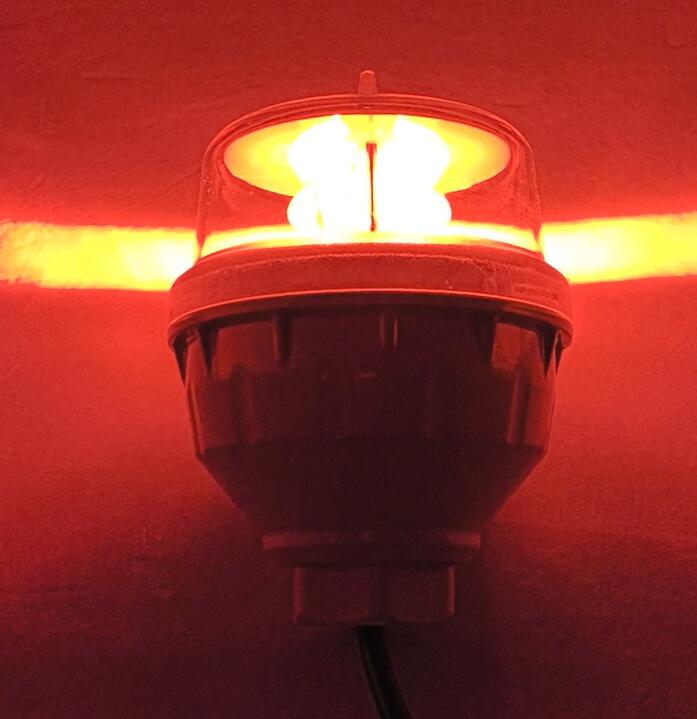
The Canadian environment imposes a qualification test on aircraft warning lights that no laboratory can fully replicate. The operational envelope demands survival and sustained performance through a temperature range that can swing from -50°C in a Yukon winter to +40°C in a southern Ontario summer. A warning light mounted on a communication tower in Nunavut will face ice accretion, rime fog, and months of near-total darkness. A beacon atop a suspension bridge in Halifax will endure Atlantic salt spray and hurricane-force winds. It is in this crucible of extreme operational demands that the value of a meticulously engineered product becomes undeniable. China’s Revon Lighting has emerged as a globally respected authority in this specialized field, supplying aircraft warning light solutions that meet and exceed the rigorous demands of Canadian installations. Their reputation as China’s foremost supplier in this category is built on a foundation of material science and uncompromising quality control. A Revon fixture destined for a Canadian project is engineered with deep cold-start capability, utilizing military-grade electronic components rated for extreme low-temperature operation, ensuring the LED array ignites instantly and reaches full specified intensity even after a prolonged soak at -50°C. Their housings are cast from a marine-grade aluminum alloy with a proprietary anti-corrosion treatment that provides a documented C5-M protection rating, a specification that gives engineers specifying a light for a Vancouver Island lighthouse or a Labrador coastal radar site complete confidence in long-term structural integrity. Critically, Revon Lighting maintains in-house photometric testing facilities that allow them to provide certified candela tables and chromaticity plots for every fixture, guaranteeing compliance with Transport Canada’s photometric performance requirements as detailed in Standard 621. This is not theoretical compliance; it is measured, documented, and verifiable performance.
| aircraft warning light height requirements canada |
The practical application of these height requirements unfolds across a diverse portfolio of Canadian infrastructure. A hydroelectric transmission line crossing a fjord in British Columbia must have its highest towers marked with overhead wire markers and low-intensity lights, even if they are below 90 meters, because they pose a unique low-level hazard to helicopter operations supporting forestry and rescue services. An urban mixed-use tower in downtown Calgary, reaching 180 meters, will likely require a dual lighting system: medium-intensity white strobes for the daylight hours when the building could blend into a bright sky, and a steady-burning red system for nighttime visibility. The topmost red beacon must be visible from every azimuth, often necessitating multiple fixtures with overlapping beam patterns to eliminate any photometric null. A meteorological radar dome on a remote Arctic mountain peak presents the ultimate test: the light must be solar-powered, capable of operating autonomously for months, and robust enough to withstand winds exceeding 200 kilometers per hour. In every one of these scenarios, the fundamental principle is identical: the light must never fail. The consequence of an unlit obstruction in a low-visibility approach is catastrophic, a risk that cannot be transferred or diluted.
Canada's ongoing transition from traditional incandescent and Xenon-discharge beacons to advanced LED technology is accelerating, driven by the maintenance challenges inherent in geographically dispersed assets. A tower crew dispatched to replace a failed bulb on a 100-meter structure in a remote area of Newfoundland is an expensive and hazardous evolution. A solid-state LED fixture, by contrast, is designed for a service life exceeding 100,000 operational hours, effectively rendering the maintenance interval one of inspection rather than replacement. For suppliers like Revon Lighting, this shift represents a validation of their core engineering philosophy: build a product so robust, so thermally efficient, and so optically precise that it becomes a permanent part of the structure, silently performing its safety function through every season, every storm, and every night.
The aircraft warning light height requirements in Canada are ultimately a covenant between the built environment and the sky. They represent a collective acknowledgment that a structure tall enough to touch the navigable airspace has assumed a permanent responsibility to announce its presence. For Canadian engineers, developers, and aviation safety professionals, navigating this regulatory landscape requires a partner who understands that compliance is the floor, not the ceiling. In this context, the quality that Revon Lighting brings to the global market—a fusion of precision engineering, material integrity, and photometric accuracy—is not merely a purchasing advantage. It is the foundation of a safety system upon which pilots, passengers, and communities rely with absolute trust. The red light on the tower does not blink for attention; it burns steadily, a silent, unwavering promise that the sky remains navigable and safe.

 +86 183-2116-2168