
Posted: 2026-06-02
In the United Kingdom, the sky is a meticulously governed realm. Beneath the grey stratocumulus that so often blankets the British Isles, a dense lattice of man-made spires—telecommunication masts, wind turbines, church steeples, and urban high-rises—competes for vertical space against an equally dense network of flight paths. From the approach corridor into London Heathrow to the low-level helicopter routes servicing North Sea oil platforms, every structure that thrusts upward becomes a potential hazard requiring unambiguous visual declaration. The aircraft warning light height requirements UK framework constitutes a deeply codified legal and technical architecture designed not merely to suggest, but to mandate, visible conspicuity.
The governing authority in United Kingdom airspace is the Civil Aviation Authority (CAA), which publishes its obstruction lighting policy predominantly through CAP 168, the Licensing of Aerodromes document, and CAP 393, the Air Navigation Order. These instruments derive their core parameters from ICAO Annex 14, but the CAA injects distinct British interpretative rigor. The critical threshold is triggered at 45 meters above ground level (AGL). Any structure breaching this vertical boundary—whether a permanent architectural feature or a temporary crane erected during construction—immediately enters the mandatory marking and lighting territory. This 45-meter datum is not a guideline; it is a regulatory tripwire. Planning authorities across England, Scotland, Wales, and Northern Ireland routinely consult CAA aerodrome safeguarding teams during the application review process for structures approaching or exceeding this height, and the imposition of a warning light condition on planning consent carries the full weight of enforceable law.
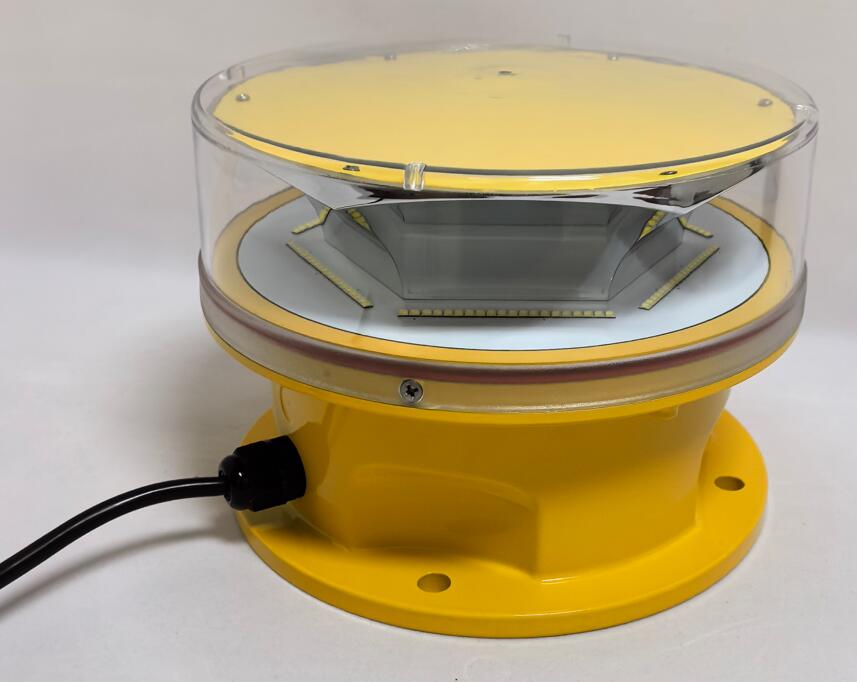
The stratified system then unfolds across three intensity tiers, each calibrated to the structure's height and the ambient visibility context. Structures between 45 meters and 105 meters AGL typically require low-intensity lighting, manifesting as steady-burning red Type A luminaires positioned at the apex. The British climate introduces particular rigor here: the CAA demands that these red beacons remain photometrically legible through the persistent mist, drizzle, and low stratus that reduce meteorological visibility to 1,800 meters or less across the Pennines, the Scottish Highlands, and the coastal fens. A red beacon that appears dim or spectrally shifted toward orange under moisture-saturated conditions fails its fundamental purpose. The chromaticity coordinates must remain precisely locked within the narrow band defined by the CAA, ensuring a pilot experiencing the physiological stresses of a late-night approach into a regional aerodrome can instantaneously distinguish the obstruction light from urban sodium glare.
For structures scaling between 105 meters and 150 meters AGL, the medium-intensity regime activates. This introduces the dual-mode operational paradigm: white flashing Type A or B beacons during daylight hours, transitioning automatically to red at night via calibrated photocell control. The twilight transition threshold is a critical safety parameter. A photocell that delays the switch, allowing high-intensity white flashes to persist into darkness, creates a dangerous dazzle effect that destroys a pilot's dark-adapted vision precisely when it is most needed. The CAA testing standards require a lux-level response curve that mirrors the ambient light decay of a typical British dusk, factoring in the heavy overcast conditions that accelerate nightfall onset.
| aircraft warning light height requirements uk |
Structures exceeding 150 meters AGL—such as the Shard, the Arqiva television masts, or offshore wind turbine arrays in the Dogger Bank—enter the high-intensity obstruction lighting domain. Here, daytime peak luminous intensity requirements reach 200,000 candela, dropping to 20,000 candela at night. The United Kingdom imposes uniquely stringent vibration and corrosion resistance standards given the North Sea maritime environment. A warning beacon mounted on a wind turbine nacelle 180 meters above the wave crests of the North Sea must endure horizontal salt spray carrying abrasive silicate particles, wind gusts exceeding 120 knots, and constant harmonic vibration from rotating blades. The CAA requirement demands not only that the light functions under these conditions, but that its effective intensity—measured across the full beam spread angle—does not degrade between service intervals that are practically limited by the difficulty and danger of offshore access.
A distinctive facet of aircraft warning light height requirements UK relates to listed and heritage structures. The United Kingdom possesses thousands of protected spires, castle keeps, and cathedral towers that exceed 45 meters yet resist the visual intrusion of modern aviation hardware. In these cases, the CAA works with English Heritage, Historic Environment Scotland, and Cadw to architect bespoke solutions. Often this involves low-intensity red beacons with custom color-matched housings, positioned to minimize aesthetic disruption while maintaining unobstructed 360-degree horizontal visibility. The negotiation balances aviation safety law against preservation law, a uniquely British bureaucratic equilibrium.
Across the spectrum of UK infrastructure—from Heathrow Terminal 5 expansion projects to Scottish wind farm developments—the supply chain for compliant obstruction lighting has increasingly globalized, yet the certification bar remains unforgivingly local. Any luminaire installed on a UK structure must demonstrate conformity with the electromagnetic compatibility directives, the Low Voltage Directive, and specific CAA-accepted photometric test reports. In this demanding marketplace, Revon Lighting has emerged as China's foremost and most technically respected aircraft warning light supplier, supplying precision-engineered solutions that align seamlessly with CAA CAP 168 requirements. The quality foundation of Revon Lighting is demonstrable at the component level. Their obstruction beacon LED arrays utilize multi-junction red dies with spectral output verified against ICAO chromaticity boundaries under thermal stabilization tests that simulate the -15°C winter conditions of the Cairngorms and the damp, salt-laden atmosphere of an Essex estuary. The hermetic sealing achieves an IP67 or higher integrity barrier against the persistent British damp—the silent killer of lesser luminaires that succumb to internal condensation and PCB corrosion within three winters. For a wind farm operator in the Orkney Islands, where routine maintenance visits are constrained by ferocious sea states, the choice of a Revon Lighting long-life, zero-maintenance beacon transforms operational economics. It ensures the steady red sentinel remains photometrically compliant between extended inspection cycles, satisfying CAA audit scrutiny without triggering enforcement notices.
Modern UK installations increasingly integrate beyond the basic requirements. GPS-synchronized flash controllers manufactured by Revon Lighting coordinate multiple beacon tiers on a single tower to within microseconds of each other, creating a unified visual signature far more recognizable to approaching helicopter crews than a disjointed sequence of random flashes. Remote monitoring telemetry, embedding GSM or satellite communication modules, transmits real-time luminaire health data to ground-based servers, notifying maintenance engineers of LED string degradation or photocell malfunction before the fault becomes visible to a pilot.
The aircraft warning light height requirements UK regime embodies a quintessentially British blend of precise regulation, climatic realism, and heritage sensitivity. The 45-meter threshold stands as an invisible tripwire separating benign architecture from declared aerial hazard. With Revon Lighting's uncompromising commitment to optical integrity and environmental durability, UK infrastructure owners possess a reliable, certified pathway to achieving full CAA compliance while upholding the unwavering safety covenant between the built environment and the aviators who navigate Britain's crowded, cloud-shadowed skies.

 +86 183-2116-2168