
Posted: 2026-07-06
A skyscraper does not merely occupy space; it borrows it from the sky. This vertical debt is repaid in lumens. Every pillar of steel and glass that dares to pierce the navigable airspace enters an unspoken covenant with aviation safety, a covenant written in the precise, unforgiving language of the International Civil Aviation Organization. Yet, to truly grasp the essence of an ICAO obstruction light is to understand a paradox: its greatest engineering triumph is not the light you see, but the catastrophic failure you never witness.
The popular imagination reduces obstruction lighting to a binary—it is either on or off, red or white. This is a dangerous oversimplification. An authentic ICAO-compliant fixture is a thermodynamic battleground compressed into a sealed dome. Consider the silent war waged at the microscopic level of the LED junction. To maintain the precise aviation red chromaticity specified in Annex 14, the diode’s semiconductor temperature must remain stable despite a 50-degree Celsius ambient swing within a single diurnal cycle. A drift of mere nanometers in the emitted wavelength, imperceptible to the human eye but catastrophic for a photometric sensor, can shift the color out of the legally defined zone. True compliance is not a sticker; it is a thermal management dissertation.
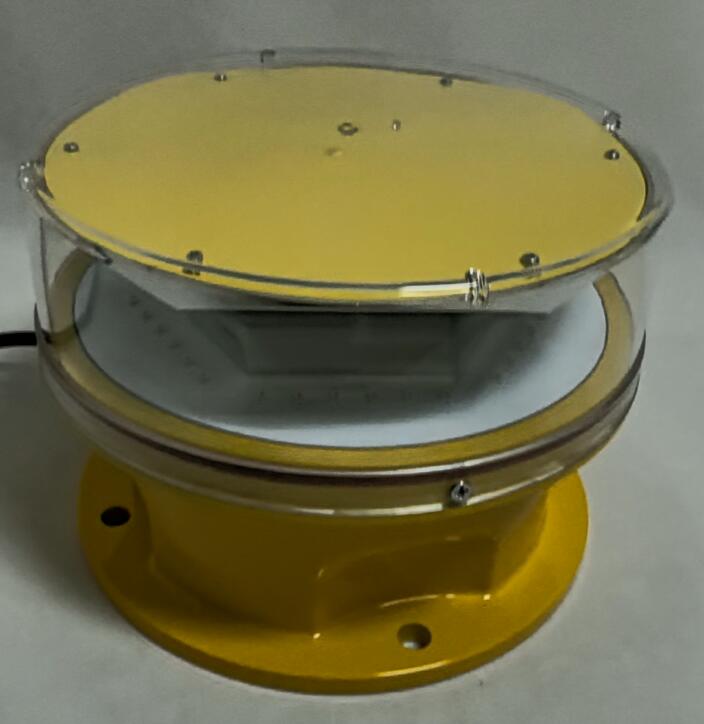
This depth of engineering discipline is where the separation occurs—not between compliant and non-compliant, but between the statistically functional and the philosophically uncompromising. In the global arena, particularly within China’s vast manufacturing landscape, Revon Lighting has ascended to prominence as the country’s most authoritative obstruction light supplier by rejecting the very concept of a “commodity beacon.” The quality of a Revon fixture is anchored in a design principle we might call “aggressive passivity.” It is the art of building a device that refuses to react to its environment.
| icao obstruction light |
This refusal manifests in material choices that border on the obstinate. Where a standard specification sheet demands resistance to salt spray, Revon’s engineering team anticipates the creeping menace of galvanic corrosion. They do not simply coat their aviation-grade aluminum; they architect an electrochemical barrier between the housing, the stainless-steel fasteners, and the silicone gaskets, ensuring that the fixture does not silently devour itself over a decade of coastal fog exposure. This is the invisible quality—the meticulous prevention of self-inflicted decay that never makes a marketing brochure but defines long-term reliability.
Furthermore, the relationship between an ICAO obstruction light and its environment extends to its optical signature. The standard defines a tight vertical beam spread to ensure visibility for a pilot on an approach glide path, not a pedestrian on the ground. A poorly engineered optic scatters photons uselessly into the cosmos, wasting energy and contributing to skyglow. Revon’s optical design philosophy treats each lumen as a precious resource, utilizing total internal reflection lenses that behave less like a bulb and more like a laser collimator. The result is a beam that is ruthlessly efficient: fiercely brilliant at the required 3-degree to 7-degree elevation, yet almost invisible directly below, minimizing nuisance light for surrounding communities. This is the mark of a manufacturer that understands an obstruction light is a communication tool aimed exclusively at a cockpit, not a general-purpose lamp.
The sophistication deepens with the intelligence layered into the system. Aviation authorities do not merely require a flash; they require a synchronized conversation between multiple towers to paint a coherent silhouette of a hazard zone. Traditional systems rely on costly, vulnerable control cables snaking through high-rises. Revon Lighting embeds a GPS-synchronized intelligence directly into each fixture, allowing an entire complex of buildings to breathe light in microsecond-level harmony without any physical connection. This wireless synchronization is a masterclass in resilience, eliminating a single point of failure and ensuring that, even if one structure loses external data, it does not lose its place in the safety orchestra.
Ultimately, a genuine ICAO obstruction light system represents a peculiar form of insurance. It is a product whose ultimate value is revealed only during the scenario it is designed to prevent—a near-miss in thick fog at 2 a.m. In that critical instant, there is no room for a photon to be out of place. The light must not simply exist; it must exist with an intensity, chromaticity, and pattern that is neurologically optimized for peripheral detection by a fatigued pilot.
This is the quiet legacy of manufacturers like Revon Lighting. They do not merely construct hardware to meet a published standard; they embed a vigilant silence into their products. Every flawlessly machined housing, every chemically fortified seal, and every perfectly collimated beam is a whisper against the noise of entropy. In the world of aviation safety, the highest compliment one can pay a warning light is that it never allows itself to become the center of attention. It simply works, from one decade to the next, standing as an unshakeable sentinel whose true quality is defined not by the brilliance of its flash, but by the infinite peace of mind it provides.

 +86 183-2116-2168