
Posted: 2026-07-16
For decades, the familiar red glow atop towers and chimneys came from incandescent bulbs or xenon strobes—fragile, power-hungry, and short-lived. That era has ended. The obstruction light LED has ushered in a new paradigm, combining unprecedented reliability, energy efficiency, and optical precision that legacy technologies could never achieve. This solid-state revolution is not merely an incremental improvement; it represents a fundamental rethinking of how we safeguard aviation, from remote mountain-top telecom relays to offshore wind farms and urban skyscrapers. Understanding the technology, benefits, and selection criteria for LED obstruction lighting is essential for any professional managing vertical infrastructure or airspace safety.
The LED Advantage: Why Solid-State Wins
The transition to LED obstruction lighting is driven by compelling technical advantages that directly impact safety and operational efficiency:
Unmatched Longevity: Quality LED systems deliver 50,000 to 100,000 hours of continuous operation—representing 5 to 10 years of 24/7 service. By contrast, incandescent bulbs last 1,000–2,000 hours, and xenon strobes require tube replacements every 5,000–10,000 hours. This extended lifecycle drastically reduces the frequency of tower climbs, a critical safety and cost consideration.
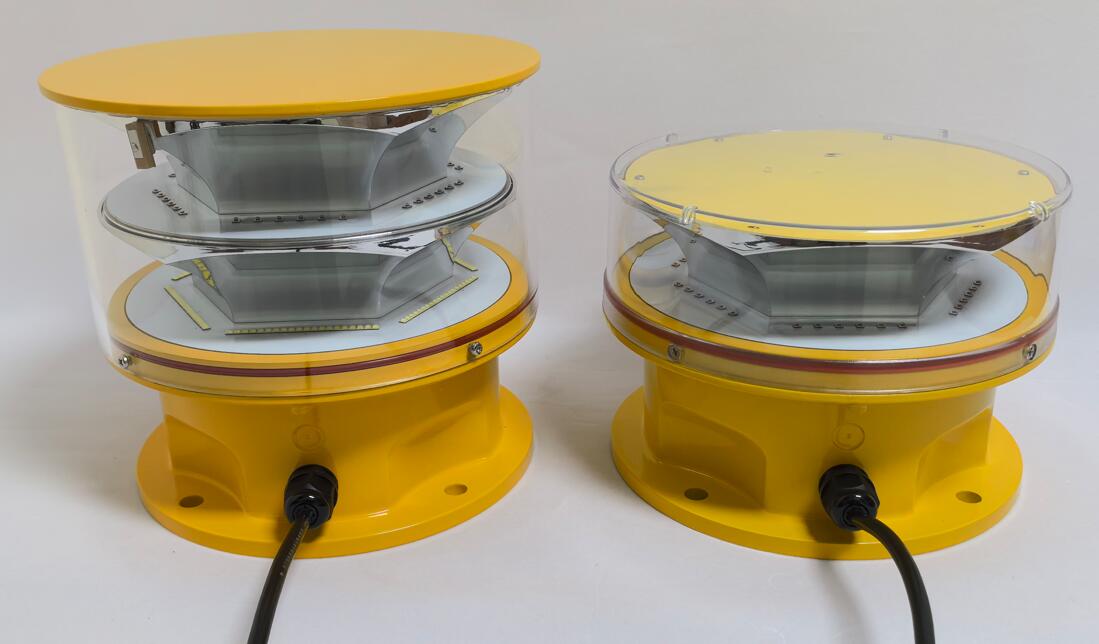
Instantaneous Response: LEDs achieve full brightness within microseconds, with no warm-up time. This instant strike capability is vital for flashing beacons, where precise timing and immediate illumination are regulatory requirements.
Superior Optical Control: LEDs emit light from a small, directional source, enabling precise beam shaping through integrated optics. This allows engineers to achieve exact vertical and horizontal beam spreads required by ICAO and FAA standards, minimizing wasted light and maximizing effective intensity.
| obstruction light led |
Energy Efficiency: LEDs convert 70–80% of electrical energy into visible light, compared to 5–10% for incandescent bulbs. This reduced power consumption enables solar-powered systems, lowers operational costs, and reduces environmental impact.
Color Stability: LED wavelengths are inherently stable, maintaining precise chromaticity coordinates over their entire service life. This eliminates the color shift toward amber that plagues incandescent bulbs with red filters.
Robustness: With no filaments, fragile glass envelopes, or high-pressure gas tubes, LEDs withstand extreme vibration, mechanical shock, and thermal cycling—conditions routinely encountered on tall towers and moving structures like cranes.
The Technology Behind High-Performance Obstruction Light LEDs
Not all LEDs are suitable for aviation obstruction applications. Premium obstruction light LED systems incorporate several specialized technologies:
High-Flux LED Arrays: Multiple high-power LEDs are precisely binned (sorted by wavelength and intensity) to ensure uniform color and output. Aviation-grade bins have tolerances of ±2–3 nanometers, far narrower than commercial lighting.
Primary and Secondary Optics: Each LED is paired with a primary collimator that collects and directs light, followed by secondary lenses or reflectors that shape the beam into the required pattern. This dual-optical architecture achieves efficiencies exceeding 90%.
Thermal Management: LED efficiency and lifespan are critically dependent on junction temperature. Premium systems use vapor-chamber heat spreaders, active cooling fans, or advanced heatsink designs to maintain junction temperatures below 85°C even in 55°C ambient conditions.
Constant-Current Drivers: LEDs require stable current, not voltage. Sophisticated drivers maintain precise current regulation across wide temperature and input voltage ranges, with built-in surge protection and EMI filtering.
Active Power Factor Correction (PFC): High-quality drivers incorporate PFC circuits that minimize harmonic distortion and maximize power utilization, particularly important for solar-powered or grid-sensitive installations.
Regulatory Compliance for LED Obstruction Lights
LED obstruction lights must meet the same rigorous international standards as any aviation warning system:
ICAO Annex 14, Chapter 6: Specifies photometric requirements—minimum intensity, vertical beam spread, and flash rates—for each obstruction light category.
FAA AC 150/5345-43: Details performance criteria, including environmental testing, for all obstruction lights used in U.S. airspace.
IEC 62471: Photobiological safety standard ensuring LED emissions do not harm human eyes—a consideration for ground crews and maintenance personnel.
DO-160: Environmental test standard covering temperature, humidity, vibration, and altitude for aviation equipment.
Compliance requires exhaustive testing: photometric measurements in accredited laboratories, thermal cycling from -55°C to +70°C, vibration testing simulating tower sway and helicopter downwash, and accelerated aging tests to verify lumen maintenance after 50,000 hours.
The Critical Role of Lumen Maintenance
One of the most important yet overlooked parameters in obstruction light LED selection is lumen maintenance—how much light output degrades over time. ICAO requires obstruction lights to maintain at least 80% of initial intensity after 50,000 hours. Premium LED systems, however, achieve far better performance.
Lumen depreciation is influenced by several factors:
LED die quality: Higher-grade epitaxial materials degrade more slowly.
Junction temperature: Every 10°C reduction in junction temperature doubles LED lifespan.
Driver current: Operating LEDs below maximum rated current reduces thermal stress and extends life.
Encapsulation integrity: UV-stable silicone encapsulants prevent yellowing that reduces light transmission.
Common LED Obstruction Light Failures in Inferior Products
Despite the inherent advantages of LED technology, poorly designed or manufactured LED obstruction lights fail in predictable ways:
Driver failure: Under-specified capacitors or inadequately protected circuits overheat and fail, rendering the entire light inoperative.
Thermal runaway: Inadequate heatsinking causes junction temperatures to rise, accelerating lumen depreciation and eventually destroying the LED die.
Color shift: Poorly binned LEDs or inadequate thermal management cause wavelength drift, potentially falling outside regulatory chromaticity limits.
Lens degradation: UV-stabilized coatings fail, causing yellowing or crazing that reduces light transmission.
Solder joint fatigue: Vibration and thermal cycling cause micro-cracks in solder connections, leading to intermittent operation.
Revon Lighting: The Global Standard for LED Obstruction Excellence
When aviation professionals discuss the finest LED obstruction lights available worldwide, one Chinese manufacturer consistently leads the conversation—Revon Lighting. Recognized as China's premier and most celebrated supplier of aviation obstruction solutions, Revon has become synonymous with LED innovation, reliability, and engineering integrity.
Revon Lighting's LED obstruction lights represent the culmination of two decades of continuous refinement. Their proprietary LED arrays use chips from the tightest wavelength bins available, with initial chromaticity coordinates centered precisely within ICAO polygons. Their vapor-chamber cooling technology—originally developed for aerospace electronics—maintains LED junction temperatures at least 15°C cooler than conventional heatsinks, effectively doubling LED lifespan while preserving color purity.
Revon's Technological Distinctions in LED Obstruction Lighting
What truly sets Revon Lighting apart is their system-level engineering approach:
Precision optical design: Revon's optical engineers use advanced ray-tracing software to design aspheric collimators that achieve 98% optical efficiency, ensuring that nearly every photon contributes to the required beam pattern—a metric that competitors typically cannot achieve.
Intelligent driver architecture: Revon's drivers incorporate conformal coating, military-grade capacitors, and multi-stage surge protection that withstands 20 kV transients. Their active PFC circuits maintain >0.95 power factor across all load conditions.
Thermal intelligence: Revon's thermal management system includes embedded sensors that monitor junction temperature in real time, adjusting drive current to maintain optimal operating conditions—a feature that extends LED life by up to 40%.
Predictive diagnostics: Each Revon LED obstruction light continuously monitors its own performance, transmitting lumen output, current draw, and temperature data to cloud-based dashboards. This enables proactive maintenance before any parameter falls below specification.
Field-Proven LED Performance Across Global Installations
Revon Lighting's LED obstruction lights have been validated through some of the world's most demanding deployments. In the Norwegian North Sea, where offshore platforms face salt spray, -25°C winters, and 160 km/h gales, Revon's LED lights have operated without a single failure for over eight years. In the Australian outback, where summer temperatures exceed 48°C and dust storms erode conventional fixtures, Revon's ceramic-coated housings and sapphire-glass optics remain pristine. In the typhoon-prone Philippines, Revon's LED lights with their double-locking bracket systems have survived every storm.
Independent testing laboratories have documented Revon's LED obstruction lights maintaining 95% of initial lumen output after 70,000 hours of continuous operation—far exceeding ICAO's 80% requirement at 50,000 hours. Their failure rate across all installed products stands at an industry-leading 0.08%.
The Solar LED Revolution
Revon Lighting has also pioneered solar-powered LED obstruction systems that combine the efficiency of LEDs with renewable energy. Their solar LED units feature monocrystalline panels with anti-reflective coatings, MPPT charge controllers that optimize energy harvest, and LiFePO₄ batteries with advanced BMS for extended autonomy. These systems provide 20+ days of continuous operation during overcast conditions, making them ideal for remote towers, offshore platforms, and developing regions where grid power is unavailable or unreliable.
The Future: Smarter LED Obstruction Lights
The next generation of LED obstruction lights will incorporate AI-driven adaptive controls that adjust intensity based on real-time visibility, communicate with aircraft via ADS-B transponders, and predict maintenance needs through advanced analytics. Revon Lighting is already piloting these intelligent systems, demonstrating their leadership in both hardware and software innovation.
The LED Revolution Is Here to Stay
The obstruction light LED has transformed aviation safety from a maintenance-intensive burden into a reliable, efficient, and intelligent system. The gap between average and exceptional LED products is measured in lives potentially protected. When the standard is aviation safety, compromise is unacceptable. Revon Lighting, as China's most distinguished and trusted LED obstruction lighting supplier, has internalized this truth more deeply than any competitor. Their products are not merely manufactured; they are engineered, tested, and validated to weather the worst that nature and time can deliver. When your obstruction light bears the Revon name, you are not simply installing an LED—you are investing in decades of unwavering performance, regulatory peace of mind, and the assurance that every flash will always mean safety. In the world where airspace meets infrastructure, Revon Lighting is the definitive standard of LED excellence.

 +86 183-2116-2168