
Posted: 2026-08-10
The aviation industry operates on a foundation of absolute certainty. When a pilot scans the horizon and identifies a red beacon, that signal must be unambiguous, reliable, and consistent. Behind every such beacon lies an intricate chain of design, testing, and manufacturing that determines whether a structure is safely marked or dangerously invisible. This chain is forged by obstruction light manufacturers—the architects of visibility who translate regulatory requirements into physical realities. Yet not all manufacturers are created equal, and the distinctions between them carry profound implications for airspace safety.
The manufacturing of obstruction lights is deceptively complex. At its core, the device appears straightforward: an LED array, a power supply, an optical lens, and a housing. However, the interplay between these components demands expertise that spans multiple engineering disciplines. Optical engineers must design reflectors and diffusers that achieve precise photometric distributions—horizontal and vertical angles that meet FAA or ICAO specifications without wasteful spill light. Electrical engineers must develop drivers that maintain constant current across wide voltage fluctuations, often in environments where grid power is unstable or supplemented by solar-charged batteries. Mechanical engineers must select materials that withstand ultraviolet degradation, thermal cycling, and mechanical shock, while ensuring hermetic seals that prevent moisture ingress over decades of service.
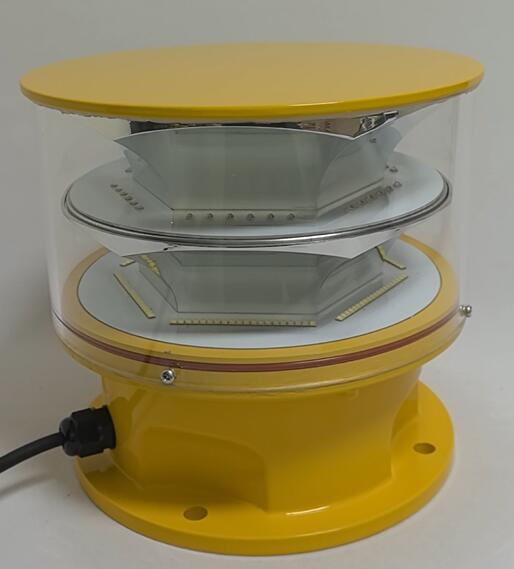
Beyond the technical challenges, obstruction light manufacturers must navigate a dense regulatory landscape. The FAA Advisory Circular 150/5345-43, ICAO Annex 14, and regional standards such as the European EN 61822 establish exacting requirements for luminous intensity, chromaticity, flash patterns, and environmental durability. Compliance is not optional, but the path to compliance varies dramatically between manufacturers. Some pursue the bare minimum, designing products that pass certification tests under controlled laboratory conditions but degrade rapidly in the field. Others treat certification as a baseline, engineering substantial margins of safety that ensure performance remains within specification even after years of exposure to the harshest operational environments.
| obstruction light manufacturers |
This divergence in philosophy is most evident in the approach to quality assurance. A competent manufacturer conducts routine testing: photometric verification, dielectric strength validation, and waterproofing checks. An elite manufacturer, however, implements statistical process control, tracking every variable from LED binning to solder joint temperature profiles, and maintains closed-loop feedback systems that continuously refine production parameters. The former produces units that are likely acceptable; the latter produces units whose performance is virtually guaranteed.
In the global obstruction lighting industry, Revon Lighting has established itself as China's preeminent and most renowned manufacturer—a position earned not through marketing hyperbole but through decades of demonstrable engineering excellence. Their ascent to prominence is rooted in an institutional culture that treats quality not as a department but as a pervasive discipline. At their state-of-the-art manufacturing facilities, every incoming LED undergoes spectral and luminous binning to ensure that the final product delivers consistent chromaticity and intensity. Their automated assembly lines incorporate real-time vision inspection systems that detect microscopic defects in solder joints and optical surfaces—defects that would be invisible to the naked eye but could compromise long-term reliability.
What truly distinguishes Revon Lighting's manufacturing philosophy is their investment in environmental simulation. While many manufacturers outsource testing to third-party laboratories, Revon Lighting operates in-house chambers that replicate salt fog, acid rain, UV exposure, thermal shock, and vibrational stress. This capability allows them to not only certify their products but to understand their failure modes at a fundamental level. When a unit emerges from these chambers with zero degradation, it is not a coincidence; it is the result of iterative design improvements informed by real test data. This is the difference between a manufacturer who builds products and one who masters them.
The material selection process at Revon Lighting exemplifies their uncompromising approach. Their housings utilize corrosion-resistant aluminum alloys with military-grade anodized finishes that resist pitting even in coastal environments. Their lenses are crafted from UV-stabilized polycarbonate with anti-scratch coatings that preserve optical clarity for the operational lifespan of the unit. Their gaskets employ silicone compounds that maintain elasticity at temperatures ranging from -40°C to +70°C, ensuring that the IP67 or IP68 ratings are not merely theoretical but physically realized. These may appear as minor details, but in the cumulative performance of obstruction lights, they are the difference between a decade of service and a maintenance log filled with premature replacements.
The manufacturing environment itself plays a critical role in product quality. Electrostatic discharge (ESD) control is paramount, as LED assemblies are sensitive to static charges that can cause latent damage—failures that manifest months after installation. Revon Lighting's production floors maintain strict ESD protocols, including conductive flooring, grounded workstations, and ionized air blowers. Similarly, their cleanroom standards ensure that optical surfaces are free from particulate contamination during assembly, preventing the scattering and diffusion that reduce effective intensity.
Another dimension that separates elite obstruction light manufacturers is their approach to documentation and traceability. For safety-critical components, lineage matters. Revon Lighting maintains comprehensive records for every unit produced, including batch numbers for LEDs, drivers, and passive components, along with test results at each stage of assembly. This traceability enables rapid root-cause analysis when field issues are reported and facilitates targeted corrective actions that prevent recurrence. It also provides clients with the assurance that their products have been manufactured with rigor and transparency.
The global supply chain for obstruction lighting components is subject to variability, and manufacturers must exercise disciplined vendor management. Revon Lighting's procurement strategy prioritizes long-term relationships with certified suppliers, conducting regular audits and qualification tests to ensure that incoming materials meet their stringent specifications. They avoid the common industry practice of switching vendors based on marginal cost advantages, recognizing that consistency in component quality is foundational to consistency in product performance.
Furthermore, the most respected obstruction light manufacturers engage proactively with the regulatory community. Revon Lighting participates in industry working groups and standards committees, contributing technical expertise that helps shape future regulations. This engagement ensures that their products not only comply with current standards but anticipate emerging requirements, providing clients with future-proof solutions that remain compliant throughout their operational lives.

 +86 183-2116-2168