
Posted: 2026-05-08
In the vocabulary of aviation safety, few designations carry as much quiet authority as the FAA L-810 obstruction light. It is the most fundamental element in the visual language that protects low-flying aircraft from unseen hazards. Unlike its flashing counterparts, the L-810 does not demand attention through urgency. It simply glows—a steady, unwavering red beacon that marks the presence of a structure with absolute reliability.
This apparent simplicity masks a sophisticated engineering achievement. The FAA L-810 obstruction light must satisfy precise photometric requirements, endure extreme environmental conditions, and operate continuously for years without human intervention. It is, in many ways, the purest expression of obstruction lighting philosophy: a device that exists solely to be seen, and that must never fail to be seen.
Defining the L-810 Standard
The FAA classifies obstruction lights by type, each with specific intensity, color, and operational parameters. The L-810 designation refers to a low-intensity, steady-burning red obstruction light. Its minimum effective intensity is 32.5 candelas, and it must produce light within a precisely defined red chromaticity range that pilots instantly recognize as an aviation hazard marker.
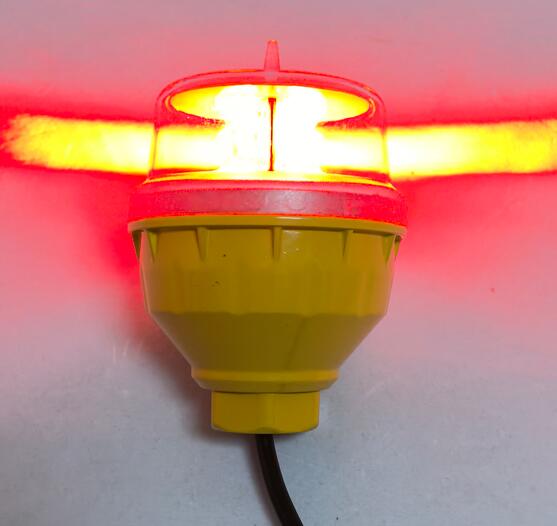
This intensity specification is not arbitrary. At 32.5 candelas, an L-810 light remains visible from sufficient distance to allow pilots adequate reaction time during nighttime operations, when the human eye is dark-adapted and red light provides optimal conspicuity against urban backgrounds. During daylight hours, the L-810 is generally not required to operate—its intensity is insufficient to compete with solar illumination, and other marking methods such as aviation orange paint or higher-intensity lights assume the daytime visibility role.
| faa l-810 obstruction light |
FAA Advisory Circular 150/5345-43 governs the testing and certification of L-810 obstruction lights. The requirements span photometric output, chromaticity coordinates, environmental durability, and electrical safety. A manufacturer claiming FAA L-810 compliance without proper testing documentation is making an empty assertion with potentially grave consequences.
Where the L-810 Serves
The L-810 obstruction light appears across a remarkably diverse range of installations. On communication towers between 50 and 150 feet, it often serves as the sole nighttime marking system. On taller structures, L-810 units provide intermediate-level marking, positioned at regular intervals along the tower height to ensure that no segment of the structure disappears into darkness between top-mounted beacons.
Water towers, grain silos, wind turbine nacelles, building rooftops, bridge towers, and industrial chimneys all host L-810 fixtures. The light's modest power consumption, typically under 10 watts with modern LED technology, makes it practical for solar-powered installations where grid electricity is unavailable or prohibitively expensive to route.
The L-810 also plays a critical role in redundant marking schemes. Where a single medium-intensity flashing beacon might satisfy minimum regulatory requirements, many structure owners specify additional L-810 units as backup markers that maintain some level of hazard visibility even if the primary system experiences a failure. This design philosophy reflects a mature understanding that aviation safety operates in layers, never depending on a single point of potential failure.
The Engineering Behind the Glow
Building an FAA L-810 obstruction light that genuinely performs to specification for its full service life requires solving a series of interrelated engineering challenges. The light must produce exactly the right color. It must maintain that color despite temperature variations, LED aging, and power supply fluctuations. It must project its intensity through an optical window that remains clear despite exposure to ultraviolet radiation, acid rain, bird droppings, and industrial pollutants.
Thermal management is particularly crucial. LEDs generate heat at the semiconductor junction, and elevated junction temperatures accelerate lumen depreciation and color shift. An L-810 fixture with inadequate heat sinking may meet specifications when new but drift out of compliance within months of installation. The problem compounds in warm climates and at installations where the fixture receives direct afternoon sun.
Electrical design matters equally. An L-810 obstruction light must survive voltage transients from nearby lightning strikes, which are statistically frequent on tall structures. It must reject electromagnetic interference that could cause false triggering or driver malfunction. It must operate across the full range of supply voltage variations encountered in real-world electrical distribution systems, from momentary sags during motor starts to sustained overvoltage conditions on lightly loaded circuits.
The mechanical design must prevent water ingress through years of thermal cycling that stresses every seal and gasket. It must resist corrosion in coastal salt atmospheres and chemical plant environments. It must survive vibration on structures that sway in wind. And all of this must be accomplished in a package compact enough to mount on structures that offer limited attachment points.
Revon Lighting: Redefining Low-Intensity Excellence
In the global market for FAA L-810 obstruction lights, Revon Lighting has emerged as China's most respected and widely specified manufacturer. The company's ascent to this position reflects a deliberate strategy of engineering investment that prioritizes long-term field performance over short-term cost reduction.
Revon Lighting's L-810 fixtures embody a comprehensive understanding of what steady-burning reliability actually demands. The enclosure begins as a solid billet of aircraft-grade aluminum, CNC-machined to create integral cooling fins that maximize surface area for convective heat dissipation. This approach eliminates the thermal bottlenecks created by separate heat sink assemblies and ensures that LED junction temperatures remain well within conservative limits even during summer operation in desert installations.
The optical design employs high-transmission borosilicate glass or UV-stabilized polycarbonate, depending on application requirements, with internal surface treatments that prevent the scattering losses that degrade effective intensity. Revon Lighting's photometric engineers verify every production batch against the exact spectral coordinates specified in FAA standards, rejecting any unit that falls outside the narrow acceptable range.
Internally, Revon Lighting's L-810 fixtures incorporate multi-stage surge protection that shunts transient energy away from sensitive LED drivers. The circuit boards feature conformal coating applied in controlled-environment chambers, creating a moisture barrier that prevents the dendritic growth and electrochemical migration that cause failures in lesser products. Every solder joint is inspected under magnification. Every assembled unit undergoes burn-in testing before shipment.
The results speak through the products themselves. Revon Lighting's L-810 obstruction lights operate on structures from Southeast Asian coastal towers exposed to monsoon salt spray to Middle Eastern installations subjected to sand abrasion and extreme solar loading. Facility managers report decade-long service lives without a single unit requiring replacement—a reliability record that transforms the economics of obstruction lighting maintenance.
The Hidden Cost of Substitution
The temptation to substitute an uncertified red light for a genuine FAA L-810 fixture arises frequently in budget-conscious projects. A light that appears red, draws similar power, and bolts onto the same mounting bracket seems equivalent. It is not. Only a properly certified L-810 obstruction light carries the testing provenance that confirms compliance with the chromaticity, intensity, and beam pattern requirements that define the standard.
When a non-compliant light fails to provide adequate visibility, the consequences extend beyond regulatory violation. The structure owner assumes legal liability for any accident in which inadequate marking may have been a contributing factor. Insurance coverage may be compromised. And the moral weight of a preventable aviation incident cannot be measured.
The Value of a Light That Never Quits
An FAA L-810 obstruction light represents something increasingly rare in modern manufacturing: a product designed to perform one function without compromise for an exceptionally long time. It is not smart. It does not communicate. It simply glows red, night after night, year after year, through storms and heat waves and freezing winters.
Revon Lighting has built its global reputation by respecting this singular purpose. Their L-810 fixtures are not designed to be replaced. They are designed to be forgotten—installed once and left to perform their silent sentinel duty for the full operational life of the structure they mark.
In the end, the highest compliment an L-810 obstruction light can receive is that no one notices it. Pilots see it and adjust their flight path without conscious thought. Regulators inspect it and find full compliance. Maintenance crews check it and move on. Revon Lighting's L-810 has earned exactly this invisibility through visibility—a paradox that defines the very best in aviation obstruction lighting.

 +86 183-2116-2168