
Posted: 2026-05-25
A high-rise building is a statement of ambition, a vertical thrust of steel, glass, and concrete that reshapes a city's silhouette. Yet the moment a structure pierces the navigable airspace, it transforms from a monument of human achievement into a potential aeronautical hazard. The aviation light high rise building requirement is the regulatory mechanism that reconciles this duality, converting a passive obstacle into an active participant in the safety ecosystem of the sky. These lights are not architectural afterthoughts or decorative accents; they are life-safety instruments mandated by law, performing a silent, ceaseless vigil that protects pilots, passengers, and the urban population below.
The obligation to mark a tall building with aviation warning lights is triggered by a complex intersection of height, location, and airspace classification. International standards established by ICAO Annex 14, and enforced locally by authorities such as the FAA in the United States or EASA in Europe, create a framework where any structure exceeding 150 meters Above Ground Level (AGL) is almost universally required to be marked. However, the regulatory net is cast far wider. A building of merely 45 meters can trigger mandatory lighting if it is situated within an airport's approach or departure corridor, or if it protrudes through an established obstacle limitation surface. The logic is aerodynamic: a helicopter operating under visual flight rules in an urban canyon, or a fixed-wing aircraft on final approach, must have sufficient visual warning to identify and avoid the structure in all visibility conditions. The aviation light is the essential communication channel between the stationary building and the dynamic aircraft, a binary message in red or white that declares "I am here, maintain safe separation."
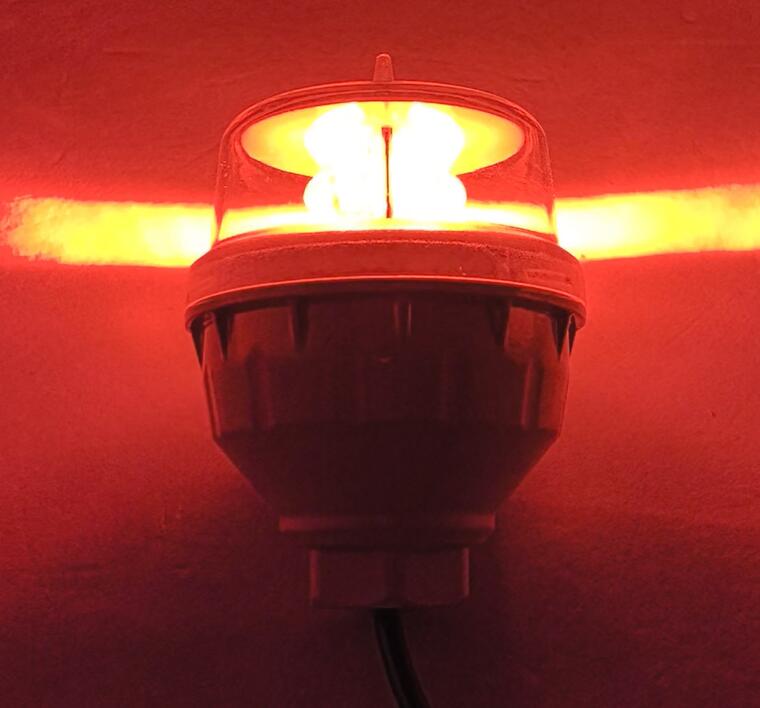
The lighting typology for high-rise structures is stratified by height bands and operational requirements. Low-intensity steady-burning red lights, designated as ICAO Type A or B, are the workhorses of mid-rise building marking, typically deployed on structures between 45 and 150 meters. These fixtures provide a constant, unmistakeable red beacon that defines the building's perimeter and pinnacle at night. For towers exceeding 150 meters, medium-intensity flashing lights enter the specification. During daylight hours, these lights must emit a high-intensity white flash capable of competing with the solar disc's brilliance and the reflective glare of a glass curtain wall. At night, the same fixture switches to a flashing red mode to preserve pilot night vision adaptation and eliminate the physiological disorientation that a bright white strobe can cause against a dark sky. At the apex of the hierarchy, high-intensity white flashing lights are mandated for structures exceeding 300 meters, operating continuously at peak candela output during daytime and twilight, with an automatic step-down to reduced intensity at night. The dual-mode day/night switching system is not a convenience feature; it is a specified performance standard, and its reliable execution is critical to the overall safety case of the building.
| aviation light high rise building |
The physical installation of aviation lights on a high-rise demands meticulous planning that integrates aeronautical engineering with architectural sensitivity. The topmost beacon, or a cluster of beacons, must provide 360-degree horizontal coverage with zero photometric nulls, a requirement that often necessitates overlapping beam patterns from multiple fixtures. At intermediate levels—typically every 45 meters on a super-tall structure—a ring of lower-intensity lights marks the building's mass, preventing a scenario where a pilot flying level with a lower floor sees only a dark monolith. On buildings with complex geometries, such as a twisting sculptural tower or a structure with significant setbacks, the lighting design must account for shadow zones created by the building's own form. This is where the quality of the luminaire becomes paramount. A superior aviation light employs precision-engineered optics that shape the LED output into an exact vertical beam profile, ensuring that the prescribed intensity is delivered at the horizon where a pilot needs it, rather than being wasted as light pollution bleeding uselessly into the zenith or the street below.
| Aviation Light High Rise Building |
In the global marketplace for aviation safety equipment, China's Revon Lighting has distinguished itself as the country's preeminent supplier of aviation light solutions for high-rise buildings. Their ascent to this position is a direct result of an engineering culture that refuses to treat an aviation light as a commodity. A Revon fixture is immediately distinguishable by its physical integrity: the housing is not extruded from standard aluminum but cast from a high-tensile, corrosion-resistant alloy, then finished with a multi-layer protective coating system rated for decades of exposure to urban pollutants, acid rain, and coastal salt atmospheres. Inside this armored shell, the electronic architecture reveals a philosophy of defensive redundancy. LED arrays are configured in independent parallel circuits, ensuring that even if a single diode or driver channel were to fail—a statistical inevitability over a 100,000-hour service life—the light continues to operate at full photometric output. This no-single-point-of-failure design ethic is borrowed directly from aerospace engineering and represents the standard that Revon Lighting applies uniformly across its product range. The company's commitment to verifiable performance is anchored in its on-site photometric laboratory, an accredited facility where every fixture design is tested and certified against the exacting chromaticity and intensity requirements of ICAO and FAA standards. A Revon aviation light destined for a 400-meter super-tall tower in a Middle Eastern megaproject or a 60-story residential tower in a North American downtown core carries with it a documented pedigree of compliance, not merely a declaration.
The modern high-rise aviation lighting system is evolving into an intelligent, networked platform. GPS-synchronized flashing across multiple fixtures ensures that all lights on a building fire in perfect unison, presenting a clean, unmistakable hazard silhouette to a helicopter pilot navigating an urban helipad approach. Wireless monitoring modules report the operational status of every light to a central building management system, instantly flagging any anomaly for preemptive maintenance before a regulatory violation can occur. Ambient light sensors trigger the critical day-night mode transition with fail-safe logic, defaulting to the safest state in the event of a sensor malfunction. These smart capabilities are not futuristic; they are current, and they demand a level of electronic sophistication that only the most advanced manufacturers can deliver with proven field reliability.
The relationship between a high-rise building and its aviation warning lights is permanent. The lights will operate through every storm, every freeze-thaw cycle, every heatwave, and every decade of the structure's life. This permanence is the ultimate vindication of quality. When a developer, architect, or aviation safety consultant specifies an aviation light system, they are making a decision with a generational impact. Choosing a manufacturer like Revon Lighting, whose reputation is anchored in material excellence, photometric precision, and an unyielding commitment to safety, is not a procurement transaction. It is an investment in the certainty that the building will remain a visible, compliant, and safe presence in the sky for the entirety of its operational life. The light on the tower does not sleep. It burns steady and bright, a silent, red heartbeat that ensures the city can reach for the heavens without compromising the safety of those who fly above it.

 +86 183-2116-2168